Editor’s Note: Patient Worthy is honored to bring you this article from our friends at the Tess Research Foundation. To see the article in its original form, please click here.
TL;DR – Variants in the SLC13A5 gene can be linked to SLC13A5 Epilepsy, a neurological condition caused by changes in the sodium citrate transporter, which is important for cellular energy. TESS Research Foundation maintains a secure patient registry and variant database to collect genetic data from affected individuals. This information helps researchers and clinicians study the gene, identify patterns and trends, and improve diagnostic accuracy. Participation in the registry may support ongoing research and the development of potential future treatments.
If you’ve received a genetic test result showing a change in the SLC13A5 gene, you might be wondering what it means–and what you can do next. This is where TESS Research Foundation and our patient registry comes in. Families can submit their child’s genetic information into a secure database through TESS Research Foundation’s patient registry. But where does the data go–and why does it matter? This post will answer these questions. As of now, we still don’t fully understand how changes in the SLC13A5 gene lead to seizures and other neurological symptoms. That’s why researchers and physicians need your help. By sharing genetic information, families help build a clearer picture of how different gene variants are linked to SLC13A5 Epilepsy.
SLC13A5 Epilepsy is caused by variants, or changes in the SLC13A5 gene
The SLC13A5 gene is an important gene that provides instructions for making a protein called the sodium-dependent citrate transporter (NaCT). This transporter brings citrate, a critical molecule for energy production, into cells.
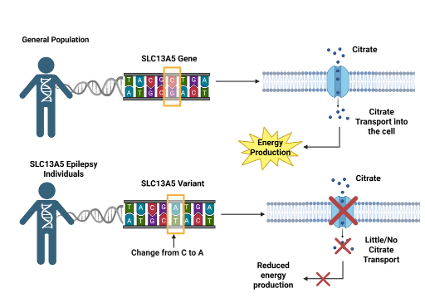
When there’s a variant (also known as a mutation) in this gene, it’s like a typo in the DNA. Some typos don’t change anything, while others can affect how the gene works – sometimes causing disease. For more information on types of mutations, you can go to our earlier article on “What are genetic mutations.” We’ve already learned important information from the SLC13A5 variant database – most of the SLC13A5 variants are missense variants, which means the typo changes the structure of the transporter protein. This can result in the citrate transporter working poorly or not at all, reducing how much citrate gets into the cells.
What is a variant database?
A variant database is like a giant library of known DNA typos. It stores information about each variant, including where it occurs in the gene, what kind of change it is, and whether it’s linked to disease. Researchers and doctors use these databases to figure out whether a specific variant is likely to cause symptoms. Is it harmful (pathogenic) or harmless (benign)? Doctors can then use the database to diagnose new patients faster and more accurately if the variant already exists.
How it works
For someone affected by SLC13A5 Epilepsy, when their DNA is sequenced during genetic testing, a variant in the SLC13A5 gene was identified. With their consent, that information can be added–confidentially and securely–to a database. By entering this data through the TESS patient registry, you’re contributing to a powerful tool for research and diagnosis. TESS has created a variant database for the SLC13A5 gene to share with the research community. Researchers can then compare your child’s variant to others in the database and search for patterns and trends–which changes are most common and which are tied to being harmful.
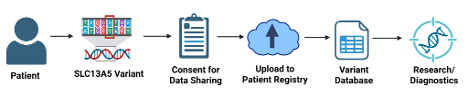
How is a variant database relevant and used in the SLC13A5 community?
A variant database is an extremely important tool for families, researchers, and doctors. We can answer questions like:
- How many different SLC13A5 variants are there in the affected community?
- What is the most common SLC13A5 variant found in affected individuals?
- What variants are missing from peer-reviewed literature and need to be studied?
- Do all known variants reduce citrate transport?
For families, variant databases can help lead to faster diagnoses, more personalized care, and eventually, better treatments. For researchers, every new entry adds a valuable piece to the puzzle, helping us understand how the SLC13A5 gene works and how to best treat the disease. The more families who share their genetic information, the closer we get to answers and treatments.
How you can help
You can make a difference in the SLC13A5 community by:
- Joining TESS Research Foundation’s patient registry
- Sharing your child’s genetic test results
- Participating in surveys or studies
Together, we can move research forward to improve the lives of every child and family affected by SLC13A5 Epilepsy.
This article was written by TESS summer intern, Sarah Gann. Sarah is going into her fourth year at the University of Notre Dame studying biomedical sciences with a focus in humanistic medicine and patient advocacy. The article was edited by TESS Research Foundation’s Scientific Director, Dr. Tanya Brown, and Director of Operations, Amber Black.
Figures were created using BioRender.com.
Is there a topic you want to see covered in Science Simplified? Let us know by emailing [email protected].
Sources:
- https://www.nature.com/articles/gim2016189
- https://medlineplus.gov/genetics/understanding/mutationsanddisorders/genemutation/
- https://molmed.biomedcentral.com/articles/10.2119/molmed.2016.00077
- https://www.mdpi.com/2218-1989/11/11/746
- https://pmc.ncbi.nlm.nih.gov/articles/PMC8537064/
- https://pubmed.ncbi.nlm.nih.gov/39091896/
- https://pubmed.ncbi.nlm.nih.gov/38113697/