 In 2017, Jamie Shultz was feeling on top of the world. She was 25 years old, engaged to the man of her dreams, had just passed the Bar exam, and was poised to start work at one of the most prestigious law firms in the country. She never could have predicted that her near-perfect life was about to be leveled like a house of cards.
It started with a strange collection of symptoms: a red, swollen ear, severe head and chest pain, heart palpitations, hair loss and fatigue. Then in December 2017, she was rushed to the ER. Her kidneys had shut down, her legs felt weak, she had a facial rash, a headache, and a confluence of other bizarre symptoms.
 By the following year, Jamie spent nearly every weekend in the hospital and barely made it to her own wedding that spring. During that period, she was so weak, she could barely walk to her mailbox.
The pain and fatigue were unremitting. She eventually had to quit her new job and go on disability. “It felt like my whole world was imploding,” she recalls. “And I just felt so powerless.”
Over the next four and half years, Jamie saw a battery of doctors and specialists from top institutions around the country – Northwestern University Hospital, Emory University Hospital, the Mayo Clinic and the National Institutes of Health – who finally diagnosed her with two rare and severe autoimmune diseases that were causing vascular abnormalities, nerve dysfunction, motility issues, and connective tissue diseases: Ehlers-Danlos Syndrome, Mast Cell Activation Syndrome (MCAS), Postural Orthostatic Tachycardia Syndrome (POTS), and myasthenia gravis. To manage her symptoms, she needed regular infusions of medication, which required her to get a chest port.
“Over time, these treatments gave me my life back,” Jamie says, “but they also caused severe allergic reactions, which sometimes put me back in the hospital.” But that wasn’t the only reason Jamie dreaded her frequent infusions. In order to prepare for access to her chest port, she had to apply lidocaine (a numbing cream) to the injection site about an hour ahead of time and then press plastic wrap over it to hold the cream in place. “That process turned out to be very frustrating and ineffective,” Jamie explained. “To prevent the lidocaine from dripping all over me, I had to lean way back while my husband applied the cream and then the plastic wrap. The plastic wrap wouldn’t stay in place very well and barely covered the cream. When I got in the car to head to the infusion center, my seatbelt would press against the plastic wrap, causing the cream to leak and get on my clothes or even in my hair. Worst of all, since there wasn’t enough cream on the injection site to make my skin sufficiently numb, the injection was very painful. I thought to myself, ‘There’s got to be a better way.’”
 Jamie searched for a product designed to facilitate the infusion prep process but there was nothing on the market specially designed to help patients numb their ports prior to infusion. Seeing a need for a solution that could not only help her, but thousands of others, Jamie took it upon herself to develop a new product designed to significantly improve the treatment experience for chronically ill adults and children who rely on a port in their fight against a broad range of diseases, including cancer, diabetes, kidney failure, chronic obstructive pulmonary disease (“COPD”), lupus, myasthenia gravis, neuropathy, chronic lymphocytic lymphoma, and more. And Jamie succeeded in doing that with the invention of her patented solution called Port Protect®.
“Port Protect® has been a game-changer for me as a patient,” says Jamie. “I no longer dread infusion preparation because I can quickly stick something over my chest port that is made of a super comfortable, hypo-allergenic material, fill the opening with lidocaine, close the lid, and go.” The lidocaine stays in place, so Jamie is protected from things like seatbelts, bra straps, and even hugs, which used to cause the numbing cream to leak. “I no longer have to deal with messes on my clothing, and—most importantly—I no longer feel pain when the nurses access my port because the lidocaine stays in place and does exactly what it’s supposed to do: numb my chest port!”
“I know how hard it is to live with chronic pain and fatigue,” Jamie says.
“Creating Port Protect® has been so gratifying because I truly believe that anything – no matter how big or small – that can improve the quality of life of someone in pain is worth its weight in gold.”
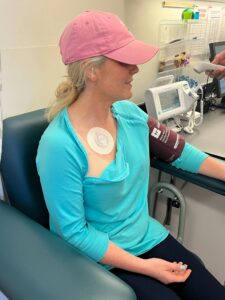
Editor’s Note: This article was originally authored by Catherine Mendelsohn. Jamie Schultz has been diagnosed with Ehlers Danlos, MCAS, POTS, and myasthenia gravis. Jamie can be reached via email address: [email protected]. For more information, visit www.port-protect.com.