When patients and families face a life-or-death disease, bureaucracy often feels like the enemy. Yet in early February 2026, the FDA delivered something rare: a formal response letter that transcended typical regulatory language to acknowledge the human reality behind medical need. This moment, captured in the FDA’s compassionate engagement with AIM at Melanoma, demonstrates how government agencies can recognize critical unmet medical needs while actively listening to the voices of affected communities.
A United Voice for Change
Advanced melanoma represents a devastating clinical reality. When patients exhaust first-line immunotherapy options, treatment pathways narrow dramatically, leaving families and patients searching for any glimmer of hope. Recognizing this crisis, AIM at Melanoma partnered with leading advocacy organizations including the Melanoma Research Foundation, Melanoma Research Alliance, A Cure in Sight, Claire Marie Foundation, and the Melanoma Action Coalition to submit a unified letter to the FDA in September 2025. Their mission was to advocate for access to RP1 + nivolumab, an investigational combination therapy that could offer a critical lifeline to patients facing advanced melanoma with limited options.
But what makes this story remarkable isn’t just the advocacy effort, it’s also the FDA’s response.
The FDA’s Empathetic Recognition
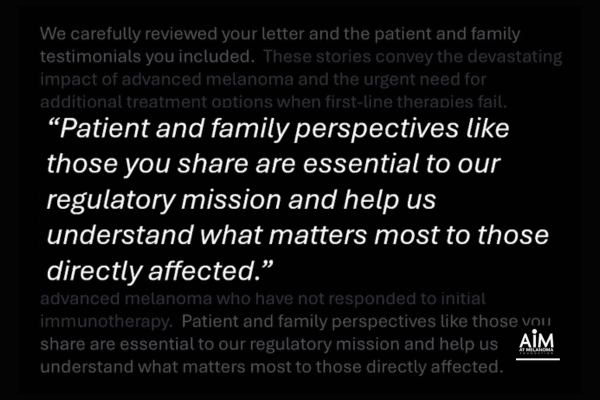
The Center for Biologics Evaluation and Research (CBER) delivered a response that acknowledged the profound human impact embedded in patient and family testimonies. The FDA’s letter explicitly recognized “the devastating impact of advanced melanoma and the urgent need for additional treatment options when first-line therapies fail.”
What stands out is the FDA’s genuine acknowledgment that “patient and family perspectives like those you shared are essential to our regulatory mission and help us understand what matters most to those directly affected.” This represents institutional listening at its finest, regulators demonstrating that they truly comprehend the stakes involved in their decisions.
Active Engagement, Not Dismissal
While confidentiality restrictions prevent the FDA from disclosing specific details about investigational products, their response confirmed something equally powerful, their review teams are “actively engaged in evaluating investigational treatments for advanced melanoma.” This commitment signals that the agency isn’t turning away from the melanoma community’s urgent needs, rather they’re working behind the scenes to advance promising therapies.
Regulatory Humanity as a Model
The FDA’s response demonstrates that regulatory bodies can, and should, combine rigorous scientific review with genuine compassion for patient circumstances. The agency acknowledged both the clinical urgency and the emotional weight of families hoping for additional options.
For advanced melanoma patients and their loved ones, the FDA’s letter may not have delivered validation that their voices matter, that their desperation has been heard, and that regulators recognize the unmet need they face.
As the fight for additional melanoma treatments continues, AIM at Melanoma and its partners remain committed to advancing access to promising therapies—and the FDA’s compassionate engagement proves that regulatory bodies can be partners in that crucial mission.
See the full Instagram post and show your support here: Instagram
See the full Facebook post and show your support here: Facebook