Editor’s Note: This story was originally authored by Natalie H., a cancer survivor and loving mother of two.
They say cancer changes everything. I’ve learned it doesn’t just change you, it reveals who you’ve been all along. I’m sharing what it’s been like to battle recurrent cervical cancer, raise my two kids, continue to work full time, and show up even when the road gets harder than I have ever imagined.
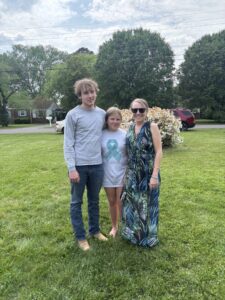 I was 36 years old when my life changed forever.
It was 2019, and what started as bleeding during intercourse and painful, heavy periods turned into something I never expected. My OB thought I might have had a miscarriage and scheduled a D&C, but there was no pregnancy, and something about how my cervix felt made her uneasy. She took a biopsy “just to be sure,” and thank goodness she did! That biopsy led to a phone call no one ever wants to receive: “I’m sorry to tell you, but the biopsy showed you have CANCER.” I had no idea how much those words would reshape every corner of my life.
“This is not just a cancer story. It’s a survival story. A motherhood story. A woman’s story of never clocking out.”
I had stage 2B cervical cancer – adenocarcinoma – non-HPV related.
The diagnosis hit me like a truck. I was healthy. I worked full-time. My pap smears had always come back clean, but the scans and exams told the full story. The cancer had already spread to a lymph node in my left groin, ruling out surgery as a curative option. From there, things moved quickly; I was thrown into chemo along with both internal and external radiation.
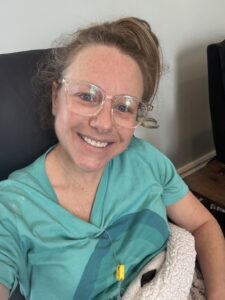 And I kept working the whole time.
People often ask how? Why don’t you take this time off? The answer is: I had no choice. I was a mom with responsibilities and somehow staying busy helped me cope. Treatment was brutal, but I showed up — to work, to scans, to my kids’ life. I showed up even when my body wanted to shut down.
After treatment, I was declared NED (no evidence of disease). It felt like a huge relief… until it wasn’t.
Six months later, I began having pain on my right side, the opposite side of my original cancer. My ovaries had been surgically moved up out of the field of radiation to try to avoid early menopause and preserve my hormones (by the way, that did not work, and I went into menopause anyway.. UGH). The pain worsened, and a visible mass began to show when I lay flat. Scans revealed a mass involving my ovary and appendix.
Surgery removed the tumor, my ovary, and the appendix along with thoroughly exploring my bowels to make sure nothing else was affected. My doctor said he’d never seen recurrence like this, on the opposite side of the original cancer, and was perplexed by this. More chemo followed, and then I began Keytruda as a maintenance treatment to hopefully prevent another future recurrence, eventually stepping back from it to feel human again.
I stayed NED for nearly two years! As a cancer patient, this is a long time, and a huge WIN!
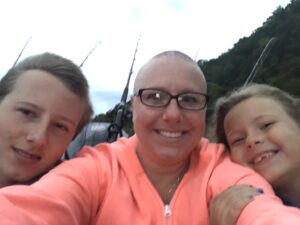 Then came another tumor on my right side again, this time in my mesentery, which is in your abdominal cavity surrounding your small and large intestines. I’d already gone through all standard chemos. My doctor recommended Tivdak, a newer drug fresh out of clinical trials. I was his first patient on it. I stopped after six rounds. “What are my next steps? Any more options?” He pushed for beam radiation or a clinical trial in Alabama, but I declined. I couldn’t uproot my life or risk further damage to my abdomen, as radiation wreaks havoc on everything in its path, even years after treatment. He didn’t take it well, and essentially dropped me.
I turned to holistic treatments: mistletoe injections, vitamin C, ART infusions. It didn’t stop the tumor, but it gave me time to think. To reconnect. To breathe.
Eventually, I found a new oncologist who actually listened, respected my concerns, and worked with me to create a plan I was comfortable with. I completed 9 rounds of proton radiation and restarted Keytruda. I’m now waiting for my next scan to see how my tumors are responding.
And yes, I’m still working full-time and showing up for my kids, as well as more appointments than you can imagine (both scans and daily Teams meetings).
 How Cancer Changed Me
It’s impossible to go through something like this and stay the same. Cancer strips you down and reshapes you.
I no longer get upset about the little things. If the house isn’t cleaned, so what? It’s not going anywhere, and will get cleaned when it does. If plans change last minute or something disrupts my routine, I don’t get stressed like I used to. I’ve learned that a shift in the schedule might just be God redirecting me toward something I never expected but really needed.
Cancer gave me a different perspective on life, one I’m honestly grateful for. It reminded me what actually matters at the end of the day: being present, loving people, protecting your peace, and trusting that things will work out the way they’re supposed to. Even when it’s hard. Even when it hurts.
What I Wish More People Knew
One of the hardest parts of living with cervical cancer isn’t just the physical toll, it’s the silence around it. The lack of awareness. The stigma.
Everyone seems to think cervical cancer is only caused by HPV, and while HPV does significantly increase the risk, it’s not the full story. You do NOT need to have HPV to get cervical cancer. Even if you’ve had the HPV vaccine, you’re not completely immune since the vaccine only covers 9 strains of the virus and there are over 200 strains total. Not all HPV strains cause health problems, but this needs to be explained to patients more clearly when getting the vaccine. I’ve met multiple women shocked that they developed cervical cancer because they had the vaccine and didn’t think that was possible.
The moment you tell someone you have cervical cancer there’s an assumption, one that’s often unspoken, but heavy. That it’s sexual. That it has something to do with how many partners you’ve had. That it’s somehow your fault, and that kind of shame keeps women quiet. To be fully transparent and honest, I was embarrassed to tell anyone what type of cancer I had when I was originally diagnosed; I did not want to be judged off my diagnosis, so I kept quiet.
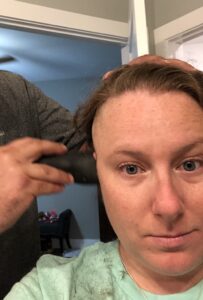 I wish it weren’t like this. I wish cervical cancer awareness was as visible and normalized as breast cancer awareness. I wish symptoms were openly discussed with girls from the time they start their periods, not just hidden in pamphlets or buried under awkward conversations. I wish OB/GYNs brought it up regularly, even when everything looks “normal” on a pap smear. I wish women did not have to advocate for themselves to eventually get a diagnosis. I’ve met multiple women who had symptoms for years, went to multiple doctors, and it was always brushed off as being hormone related and not taken seriously. Prostate cancer is taken very seriously for males, why not cervical cancer for females?
I had never even really heard of cervical cancer before I was diagnosed with it, but I knew all about breast and prostate cancers.
Why are women still fighting to be heard?
Why don’t we talk about it?
Why is there so much shame?
Why is it treated like the “easy” cancer, when in reality, recurrence is common, and treatment is brutal?
On top of that, cervical cancer often steals a woman’s ability to have children, or throws her into early menopause, no matter what her age. These days, it seems like women are being diagnosed younger and younger. It’s devastating. You’re told you have cancer, and then suddenly you’re also expected to make immediate decisions about your future fertility, decisions that typically involve IVF, egg retrieval, surrogacy, or other interventions.
 Can you imagine being diagnosed with cancer and, in the same breath, being asked to decide how to preserve your fertility? Can you imagine the decision to not have children being made for you? This is essentially what happens when you get your diagnosis. There’s barely time to process the diagnosis, let alone navigate the costs, the risks, or whether you’re even ready to be a parent. If you don’t act fast, before treatment begins, that window can close for good. You have no say in the decision on your fertility; cancer makes that decision for you. This can be just as life-changing as a cancer diagnosis, yet it’s not discussed or made aware of until it’s too late.
Sure, there are options out there, but are they accessible to everyone? Does every woman have the ability – financially, emotionally, or physically – to pursue fertility treatments? These procedures are often extremely expensive and rarely covered by insurance. For many of us, the choice is already made the moment we’re told we have cancer. I thank God for being able to have two children before my diagnosis, because my fertility was taken from me without the chance to prepare, or even fully understand what that loss would mean. And that loss can be very heavy once it sinks in.
This is not an “easy” cancer, and it doesn’t need to be shrouded in silence or shame.
We need to talk about it — loudly, openly, and unapologetically.
Final Thoughts
This disease has taken so much from me: my health, my fertility, my comfort. But it has also given me a voice, a mission, and a new lens on life. I’ve had to learn to advocate for myself, ask hard questions, and take control of my story when others tried to write it for me.
This is my third time fighting cancer, and I’m still here.
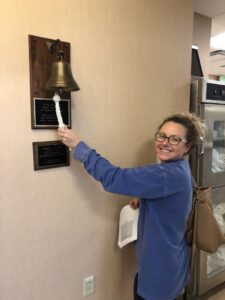 One diagnosis doesn’t mean the end. One recurrence doesn’t mean you give up. You can keep going. You can reclaim parts of yourself again. You can build a life even in the middle of the chaos. It’s not easy, but it is possible.
To anyone going through something like this: You are not alone. You are not powerless. You do not have to follow anyone’s path but your own.
I’m still here. I’m still fighting. And I’m not done telling this story, because it’s not over yet.