
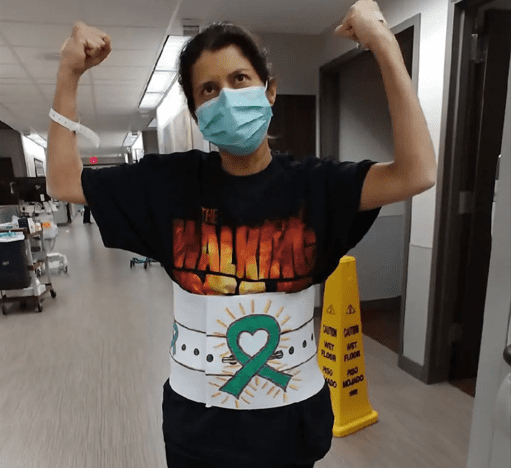
It started with an itch.
When I was 26 years old (2001), I started having an itch on the bottom of my feet. It was brief at first, but then it became a nuisance and eventually spread to the palms of my hands. I didn’t understand what was happening. I went to many doctors, telling them how this itch was taking over my thoughts and focus. I struggled to do ordinary things because I couldn’t stop itching. It was so bad that people would ask me if I was okay because I was constantly scratching. I felt like I was losing my mind.
One day I went to a new doctor, recommended by a friend who would eventually become my husband. When I stressed to him about my issues and how no other doctor had helped me, he listened. He ordered a full panel, and the results showed elevated alkaline phosphatase levels—high enough that he suggested I see a gastroenterologist. My visit with a gastroenterologist revealed that I had Primary Biliary Cirrhosis (now called Primary Biliary Cholangitis). He told me it was relatively new and didn’t have much information to give me except to refer me to a hospital five hours away that focused on liver disease. I can’t even begin to describe my thoughts and feelings learning this.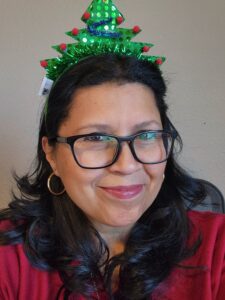
I was only 28 years old, never a smoker, never a drinker, no kids, nothing—and now I was being told I had an autoimmune condition. Talk about feeling like life wasn’t fair. At my visit to the new clinic five hours away, I learned more. I was told it mostly targeted older Hispanic women. I was not older! The good news was that they had a treatment that could help sustain my liver, and I was told I would live a long life and likely never have to worry about it becoming severe. Not that it was a lie, but my story turned out differently. What I learned later was that stress deeply affected how I felt and how my body handled everything. At the time, I was just starting my life and didn’t truly understand stress yet. With medication, I did well for many years. The itching went away after a few months and only came back occasionally—nothing I couldn’t handle.
Fast forward to 2016. I was now a wife, a mother of two beautiful girls, and working in the most stressful position I had ever had. While attending a work conference, I became very ill—so much so that I struggled to participate in the classes. As soon as my plane landed back home, I went straight to the emergency room. I found out I had colitis, gastroenteritis, and at least one or two more -itis conditions. During a follow-up with a new gastro physician, I learned I needed a transplant. He sent me back to the same hospital where I had first been diagnosed. I went through a three-day evaluation, meeting with multiple doctors who assessed my entire body to determine if I was healthy enough to withstand a transplant. At that time, I didn’t feel sick anymore and thought it was all a waste of time. Three weeks later, I learned I had been placed on the transplant list with a MELD score of 14. I didn’t even know what that meant yet. Again, I told the doctors there had to be a mistake—I felt fine. My doctor explained that my body had adapted to feeling the way I did, so I didn’t realize how sick I truly was. They also told me something that didn’t make sense at the time but stayed with me. My blood type, B+, was less common, and there was no way to know how long I might wait for a liver. They explained I could choose to accept any liver that became available, but I didn’t fully understand what that meant yet—and again, I felt fine. My stomach began bloating horribly. I barely ate due to repeated esophageal varices banding procedures and frequent paracentesis for ascites. I made several trips to the ER in my hometown and at the hospital five hours away.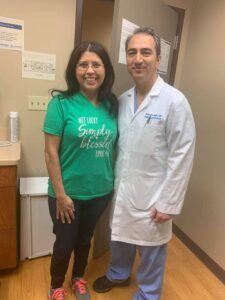
The visits became more frequent as time went on. It’s very hard being sick, getting sicker, and knowing that someone else has to pass away in order for you to have your life saved. I’m a very prayerful and faithful person, and this was one of my biggest struggles. I prayed for healing because that was all I wanted. I had two daughters who needed their mama, and I knew I had to fight. Right before Thanksgiving in 2018, I was hospitalized for five days over the holiday. They kept me in hopes that a liver might become available since MELD scores are often higher during hospitalization. The hope was there, but the call never came. I was released with a follow-up appointment scheduled for December 3rd.
Staying positive is what kept me alive.
As Christmas approached, I felt my body fading. I was too weak to do many of the things that still needed to be done. I began sharing life lessons with my 12-year-old because she needed to hear them. I held my little one as tightly as I could so she would remember my arms. At my follow-up appointment, my doctor looked sad. He had grown close to me and my little family, and the look on his face told me everything. That’s when I reminded him about something he had told me when I first joined the transplant list. I asked if it was still possible to sign whatever waivers were needed to accept any liver that became available. His face lit up with a huge smile. “Of course,” he said, “if that’s what you want.” I had a couple of questions. Was it possible for me to contract something that I could pass on to my family? He explained how far medicine had come and that anything that might come with a new liver could be treated or cured. That was all I needed to hear. I signed the waiver.
The staff were excited, and even though I didn’t fully grasp everything at that moment, I knew one thing I needed to fight.
On December 7, 2018, a huge snowstorm was heading toward our town from the direction of the hospital. My husband had gotten up at 3 a.m. the night before to travel for a trade show and returned home exhausted at 8 p.m. He sat in his recliner and fell asleep immediately. I was already in bed when my phone rang from a restricted number. I almost didn’t answer….but I did.
It was THE call.
They asked if I could come in as a backup. I was scared and skeptical. A massive winter storm was coming, and my husband hadn’t slept. But I was dying, and I didn’t want to die. I woke him up and said, “Let’s go.” Within 20 minutes, we were on the road, driving five hours through a winter storm toward the hospital. I was blessed with an incredible support system. Friends, family, and churches were praying for me. I had a group chat with everyone who wanted updates, and that night I sent one message: “We’re on our way—start praying!” Even though I was a backup, I received the liver. My husband, my two girls, and my best friend were by my side. It was a lot to endure, but it was nothing compared to what I had been feeling before.
If you are newly diagnosed, I want you to know that life is not meant to be lived in constant fear or stress. Positivity can be powerful medicine. When you feel like you’re losing hope, reach out to someone you trust. You are not alone in this battle. I survived, and you can too. If my story helps even one person feel less alone, follow my journey on Facebook at “I Survived, You Can Too.” Since my transplant, I’ve vowed never to take life for granted. I don’t worry about the little things—or even the big things—the way I once did. I started a dessert catering business and a social media management business, work full time, and cherish being a mom and a wife. There was a time when my future felt foggy. Now, I see a big, beautiful, bright future, and I can’t thank God enough. Don’t lose hope. You’ve got this.
Author bio:
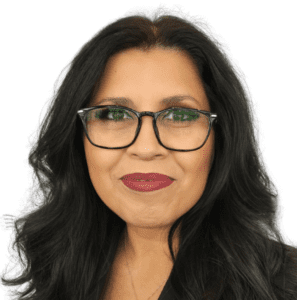 Patricia a liver transplant survivor, advocate, and voice for resilience. After being diagnosed with Primary Biliary Cholangitis at a young age, her health journey ultimately led to a life-saving liver transplant in 2018. Through sharing her story, Trish hopes to encourage others facing chronic illness to trust their instincts, stay informed, and never lose hope. Today, she uses her experience to uplift and empower others, raising awareness about organ donation, life after transplant, and the strength found in perseverance.