
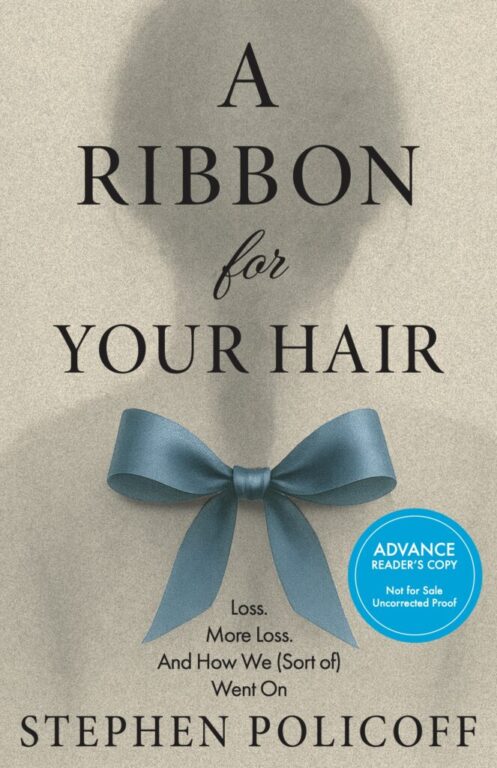
Editor’s Note: The following in from author Stephen Policoff, whose book A Ribbon for Your Hair is out today!
Introduction
When Stephen Policoff’s adopted daughter Anna was four, a freak accident sent her to the ER at Manhattan’s Saint Vincent Hospital. Within hours, he and his wife, Kate, were reeling from the shocking news that Anna had a mysteriously enlarged liver and spleen. Seven months and countless tests later, the Mayo Clinic delivered a devastating diagnosis—Niemann-Pick Type C, a rare and fatal genetic illness. Most children with it do not live past thirteen.
Refusing to let fear define them, Stephen and Kate—at Anna’s urging—adopted a second child from China, named her Jane, and worked to create as “normal” a family life as possible.
Then tragedy struck again. Kate was diagnosed with late-stage lung cancer, plunging the family into more rounds of treatment and hospital visits, ultimately leaving Stephen alone to raise Jane and care for Anna during her final years. The following is an excerpt from his memoir, A Ribbon for Your Hair: Loss. And More Loss. And How We (Sort of) Went On.
Excerpt
We went to the Mayo Clinic to get confirmation of what we feared
from Dr. Patterson, the leading expert in Niemann-Pick C. We also
went there because we were told that if there was to be a clinical trial of
OGT-918 (called Zavesca in the U.S.), it would be managed through
Dr. Patterson. But the clinical trial kept getting shunted aside. In May
2000, they told us it would probably be within a year. It turned out to
be four years. During that time, Anna’s gait became more wobbly, her
speech more slurred, her gorgeous eyes more unfocused.
But she went on being who she was—a kid who brought joy to
almost everyone who met her, a kid whom other kids flocked to, a kid
who never met a meal she didn’t enjoy, a game she didn’t want to play.
One day in June 2004, Kate received a call from the National Institutes
of Health. The Zavesca trial was on! Anna had been selected
to come to the NIH to see if she qualified for the trial. Kate canceled
a work trip, journeyed with Anna to the NIH, and for a few days we
felt optimistic.
Zavesca is an iminosugar—an analog of sugar. It is a common element
in vegetation, which may be one reason certain plants have medicinal
value. In humans, this chemical compound interferes with the
processing of one of the substances—glycosphingolipids—which is
responsible for the neurological damage of Niemann-Pick C.
It was already authorized by the FDA for use in Gauchers Disease,
another lysosomal storage disorder. Because it could cross the
blood-brain barrier it was the source of considerable hope in the NPC
community.
And there wasn’t a lot of hope otherwise.
Unfortunately, one of the key measurements to see if the drug actually
worked on NPC kids was eye movement, and Anna’s supranuclear
gaze palsy had progressed too far. The NIH researchers gently told
Kate that Anna could not be in the trial because it was no longer possible
to measure how well she did on the drug.
Kate came back from the NIH sunk in gloom. Anna, of course, was
thrilled to have had three days in some hotel with Mommy. She knew
Kate was sad, and this worried her a little, but she still said, “Had fun
there, Daddy!”
Gloom is my default setting, but for some reason, perhaps to counter
Kate’s dark mood, I found myself oddly upbeat. “She’s going to get
this drug,” I said. “And it’s going to help her.”
A few weeks later, Dr. Patterson called us. Although Anna was not
eligible for the trial, he was authorizing her to receive Zavesca anyway. “We believe it will help,” he told us. He emphasized that it was not a cure but a treatment which might—might—ease her symptoms. It
would plateau eventually, but might—might—give us a few more years.
The only catch: it cost $90,000/year and most health insurance
plans would not cover it.
Kate, who worked for Panasonic as a sales manager for 25 years, had
a contentious relationship with the male-dominated structure of that
vast corporation. But Panasonic had a self-funded healthcare plan. In
theory, if her bosses agreed to it, Zavesca could be provided to us. For a
week, she went back and forth between the desire to demand what we
needed and the fear of being swatted down by men she mistrusted.
“Should we mortgage the house?” Kate wondered. “I just don’t see
how I can get my asshole bosses to cover this!”
But I knew she would try; when Kate was convinced something
needed to be done, it got done. She just needed time to work herself up into a proper rage.
By August, she was determined.
“I am not going to cry,” she told me, “I am just going to tell them
they have to do it.”
She marched into her boss’s office that week. She did cry, she admitted
later, and no one at Panasonic had ever seen my incredibly strong-willed wife cry. Maybe that’s what sealed the deal? Her stonefaced boss blanched, shrugged.
“OK,” he stammered, “OK…we’ll figure out how to do it.”
They did.
For the next 10 years, we received a package of Zavesca every month.
Anna had to take six of the tiny white capsules a day. Of course, there
were side effects, notably nasty diarrhea, sometimes at wildly inopportune
moments.
“It’s not your fault,” we assured Anna. “It’s the drug’s fault.”
“Janejane, drug’s fault!” Anna would gleefully tell her sister, whenever
we had to clean up one of these thoroughly unpleasant accidents.
But within a few weeks, there were positive changes. Anna could
walk better, she actually ran across our yard upstate for the first time
in years; she had more energy, her eyes did not seem quite as glazed.
At first, we were hesitant to believe these changes, till Jane began
to cheer and chant “OGT-918! Doing things for Anna that are great!”
and friends who had not seen us for a while said, “What’s up with
Anna? Is she…better?”
She was. It didn’t last nearly long enough, but for the next three
years, there was just enough hope to briefly dispel the darkness.
About Stephen Policoff
 Stephen Policoff’s first novel, Beautiful Somewhere Else, won the James Jones Award and was published by Carroll & Graf in 2004. His second novel, Come Away, won the Dzanc Award and was published by Dzanc Books in 2014. His third novel, Dangerous Blues, was published in2022 by Flexible Press. He is clinical professor of writing in Liberal Studies at NYU. Several pieces of this memoir were first published in december, Riddlebird, Entropy Literary Journal, and Oyster River Pages. A section on Anna’s joyous experience in music therapy won the Fish Short Memoir Award in 2012, and subsequently appeared on music therapy websites around the world.