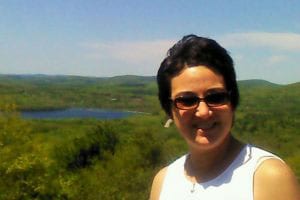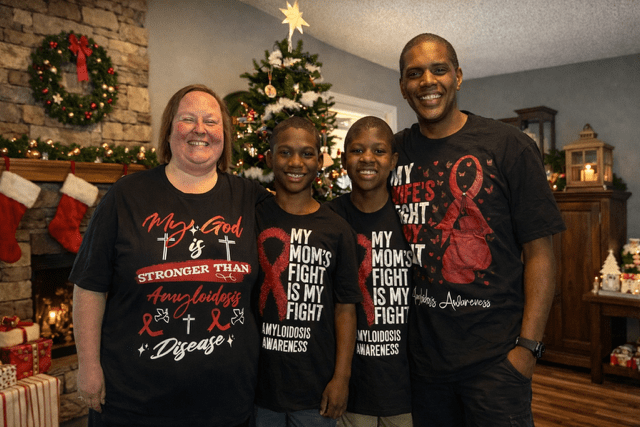
My name is Faye. I’m blessed to be the wife of the love of my life, Brad, and the proud mom of two extraordinary boys we adopted in 2013—now teenagers who keep our home full of energy, laughter, and perspective. Our dog, Snake—yes, that’s really her name—may raise eyebrows when people hear it, but she is the kind of loyal companion who somehow knows when to curl up beside me exactly when I need it most.
We’re a family that thrives on adventure, faith, and finding joy in everyday moments. Even when life looks different than we expected, we choose to move forward with purpose, courage, and gratitude.
But my family’s story with amyloidosis began long before my own diagnosis.
In 2009, my father was diagnosed with amyloidosis after a long and confusing medical journey. For months he endured test after test, biopsy after biopsy, trying to uncover why his body seemed to be failing him. He had swelling, shortness of breath, and weakness in his legs that appeared almost overnight. After his thirteenth biopsy, doctors finally discovered amyloid deposits—but the disease was initially misdiagnosed as AL amyloidosis rather than hereditary transthyretin amyloidosis.
By the time the diagnosis was corrected, the damage to his heart had already progressed too far. We lost my dad in 2010.
Before he passed, he asked my sister and me to get tested for the genetic mutation responsible for hereditary transthyretin amyloidosis. My sister did. I didn’t.
Fear convinced me that not knowing would somehow protect me. When my sister’s test came back positive, I told myself that meant I must be safe. After all, it was a 50/50 chance.
Looking back now, I understand how wrong that thinking was.
Years later, in 2018, my body began showing signs that something wasn’t right. I started retaining fluid rapidly—so much that I gained nearly 25 pounds in a single month, and my stomach became rock-hard. My doctor sent me to a lymphologist, hoping it was a lymphatic issue, but nothing improved.
The shortness of breath continued to worsen. The fatigue became relentless. Something inside me knew that my body was trying to tell a deeper story.
An echocardiogram eventually revealed thickening in the left ventricle of my heart, but even then, transthyretin cardiac amyloidosis (ATTR-CM) wasn’t considered. For two years I went from doctor to doctor searching for answers.
It was my sister who finally said the words I had been afraid to admit out loud.
“Faye… this sounds just like Dad.”
Even then, fear kept me silent about our family history. I worried about what a genetic diagnosis might mean—for insurance, for my future, for my children. But with my sister’s encouragement, I finally ordered the genetic test.
The test kit sat on my kitchen table for two weeks. Every day I walked past it, looked at it, and felt my breath catch in my chest. I knew that mailing it could change everything.
When I finally sent it in, I cried the entire walk to the mailbox.
In March 2020, during the height of the COVID shutdown, my doctor called with the results. I tested positive for the hereditary mutation that causes ATTR-CM.
In that moment, all I could hear was my own fear echoing in my mind: I’m going to die.
At the time, even my doctor knew very little about the disease. But to her credit, she refused to accept that lack of knowledge as the end of the story. She began researching day and night, learning everything she could about amyloidosis and how to treat it. Today, her understanding rivals that of many specialists, and I will always be grateful for her determination to help me fight.
Receiving a diagnosis like ATTR-CM forces you to make a decision about how you will live the rest of your life.
You can spend your days mourning the future you thought you would have… or you can embrace the life you still have in front of you.
At first, I desperately wanted control. I wanted to organize this disease, manage it, somehow bend it to my will. But amyloidosis teaches you something deeply humbling: control is mostly an illusion.
What we do have is time.
Precious, fragile, unexpected time.
And sometimes, with a disease like this, you’re given the unusual gift of knowing that time matters more than you ever realized.
A terminal diagnosis doesn’t always mean the end is immediate. Sometimes it means you have years—years to love deeply, to create memories, to say the things that matter most.
I’ve learned to treasure ordinary days because those are the moments that build a legacy.
My husband, Brad, lives out our wedding vows every single day with unwavering love and patience. Our boys inspire me constantly—they are the reason I keep showing up, keep teaching, keep fighting. I’ve started writing letters and journals filled with stories, advice, and love for them to hold onto in the future.
Time looks completely different to me now. It’s no longer something I simply move through—it’s something I honor.
Sharing my story has also become part of my purpose.
For two years I searched for answers that should have come sooner. That lost time weighs heavily on me, but it also fuels my passion for awareness and education. Early diagnosis can change lives because treatments now exist that can slow the progression of this disease.
By sharing my journey, I hope fewer families will have to experience the same confusion and delay that my father and I did.
In many ways, I feel like I’m continuing the work my dad started without ever realizing it—putting a face to a disease that too many people still know nothing about.
My journey with amyloidosis is still unfolding. Some days are hard. Some days are beautiful. Most days are both.
But through it all, my faith remains my anchor.
I don’t know how many chapters are left in my story, but I do know this:
I will fill them with gratitude, purpose, and love.
And I will make every moment count. ❤