This patient story is sponsored by Chiesi Global Rare Diseases and is promoted through the Patient Worthy Collaborative Content program. We only publish content that embodies our mission of providing relevant, vetted, and valuable information to patient communities. If you are interested in speaking with a Mentor, please click here.
When Elizabeth answers the phone now, she often begins the same way:
“Hello, my name is Elizabeth, and I will be your Mentor for this call.”
On the other end is usually a patient or a parent whose world has just been split into before and after. A diagnosis has arrived, and with it, a flood of fear, confusion, and grief that has no easy outlet.
Every time Elizabeth introduces herself, she remembers the version of herself who once whispered a very different sentence into the quiet of her home:
I wish I had someone to call.
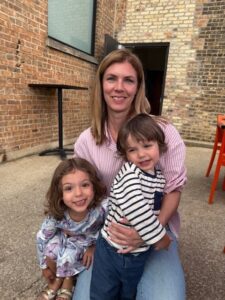
Today, Elizabeth is a part-time consultant and the mother of two children, Demah and William, both diagnosed with junctional epidermolysis bullosa (JEB), a rare genetic skin disorder characterized by fragile skin and mucous membranes that blister easily in response to minor injury, friction or heat. She is also a formal Mentor in the FILSUVEZ Friends Mentor program. Her journey from isolated, distressed parent to trusted guide shows how structures built by companies and communities can do more than treat a disease, they can begin to heal the isolation that so often surrounds it.
Elizabeth is now the voice she desperately needed: a living, breathing reminder that while EB is life-changing, it does not erase joy, possibility, or hope.
The Diagnosis: Alone When It Mattered Most
Everything changed the day Demah was born.
The delivery was difficult. When she arrived, she wasn’t breathing. As the medical team worked urgently, Elizabeth caught sight of something that made her heart seize, abrasions on her baby’s delicate skin. Within days in the NICU, blisters began to form anywhere fabric or equipment touched Demah’s legs.
Years before, when Elizabeth froze her eggs, she had them genetically tested. She was told she carried an EB mutation but was also reassured in the same breath that “Everybody is a carrier of something. Don’t worry.”
Now, in that fluorescent-lit hospital room, worry became a permanent companion.
Demah was tested for EB. The wait for answers stretched into six long weeks of sleepless nights, silent bargaining, and fear that had no name yet but was already reshaping Elizabeth’s inner world.
When the dermatologist finally called, the words were delivered in a level, clinical tone:
“I’ve seen it get better, and I’ve seen it get worse.”
To the doctor, it was an honest, neutral statement. To Elizabeth, it felt like being dropped between two cliffs with no bridge in sight.
She fled to her husband Nick’s office, sobbing. The grief and panic were so overwhelming that she couldn’t bring herself to attend the follow-up appointment with her husband. Later, she texted family with a message that read like both warning and plea, “Please don’t Google it.”
In one quiet, piercing moment, another thought surfaced, If she lives, I don’t know what kind of life she will have.
That uncertainty was almost as painful as the diagnosis itself.
A Void Where Guidance Should Have Been
As the appointments piled up, another reality set in. Most of Demah’s doctors had never seen a case of EB before. They did their best to coordinate care by making referrals, prescribing ointments, and suggesting dressings. But no one could tell Elizabeth what daily life would look like; how to hold her baby, how to dress her, how to navigate the fear of causing pain with every touch.
No one assured her that she’d find a new normal and not always feel this lost.
COVID-19 made everything harder. Elizabeth attended appointments alone, masked and distanced, while Nick waited outside in the car. The physical separation mirrored the emotional distance she felt from the rest of the world. She was walking through something very few people even knew existed.
In the middle of the night, she turned to what so many desperate parents turn to, research. She studied genetics, protein structures, and potential therapies. She scoured articles and medical journals, trying to build a map of a landscape she’d never wanted to cross. But online searches often led her to graphic images and worst-case scenarios.
A haunting question rose again and again, If I don’t understand this, how can I help my child?
Living With Worry: The Unseen Burden of Early Parenting with EB
Life at home became a choreography of hypervigilance.
Elizabeth was afraid to hold her baby skin-to-skin. What if her touch caused more blisters? She began hand-sewing fabric seams, turning clothing inside out to prevent rough edges from rubbing against vulnerable skin. Every diaper change, every outfit swap, every moment of contact was a risk calculation.
On the outside, she smiled for photos and tried to savor ordinary milestones. On the inside though, she was breaking.
“I loved my child deeply,” she would later say, “but I was living in fear.”
When her son William was also diagnosed with JEB, Elizabeth hoped it would be easier the second time. Familiarity, she thought, might soften the blow.
It didn’t.
 William quickly developed wounds that have taken years to heal. Dressing changes became a ritual of emotional endurance. He would cry and beg her to stop, but she would press on, torn between the pain she was causing in the moment and the knowledge she was trying to prevent something worse.
Her heart was shattering, but each day she put on a brave face while fear sat like a weight in her chest.
What she needed most in those years wasn’t just another article, another appointment, another medical term. She needed someone who understood the emotional toll, not just the clinical facts. She needed a voice saying, “I have felt this exact fear, and here is how I kept going.” She needed a mentor to tell her that grief, anxiety, and overwhelm were not signs of failure, but evidence of how profoundly she loved her children.
She needed validation that survival, not perfection, was enough.
But no one like that appeared.
Experience with FILSUVEZ® (birch triterpenes): “Finally, Something to Try”
For years, Elizabeth managed Demah and William’s wounds with what was available: topical ointments, steroids, compounded medications. The routine was exhausting, and long-term, meaningful progress often felt out of reach.
Then came news that shifted the air in the room, FILSUVEZ had been approved for dystrophic and junctional EB.
For Elizabeth, it was more than a product name, it was the first time she felt that someone, somewhere, was building something specifically for kids like hers.
“Finally real progress for families like mine,” she thought.
She read everything she could about it, brought it to her dermatologist, and together they decided to try it.
Elizabeth’s experiences with FILSUVEZ are her own and may not be typical. Only a healthcare provider can determine if FILSUVEZ is right for you or your loved one. Please talk to your doctor about the potential benefits and risks.
Over time, Elizabeth began to notice measurable progress. FILSUVEZ was especially useful on acute and stubborn wounds, “almost like sealing it,” she says. For the first time, wound care felt less like an endless loop and more like a path with markers of hope along the way.
For Elizabeth, FILSUVEZ represented more than a treatment option. It felt like a visible sign that the world was paying attention to EB, that their children’s pain was seen, and that innovation was possible.
FILSUVEZ Disclaimer: Elizabeth’s experiences are her own. Individual results may vary. Please consult your healthcare provider for medical guidance and refer to the full Prescribing Information and Important Safety Information for FILSUVEZ below.
From Patient to Advocate: Finding Her Purpose
The real transformation in Elizabeth’s life began when she found the EB community.
Online groups and advocacy organizations introduced her to other parents who had walked this exact path, people who knew the language of dressing changes, insurance battles, and middle-of-the-night dread. They shared the practical wisdom that doesn’t appear in textbooks like which clothing fabrics worked best, how to talk to schools, how to handle stares in public.
Slowly, Elizabeth realized that the knowledge she had painfully gathered, about treatments, about emotional survival, about navigating complex healthcare systems, was exactly what newly diagnosed families needed.
“I can be the person to others I desperately needed when Demah was diagnosed,” she thought.
She began participating in social media support groups and lending her voice to advocacy efforts aimed at accelerating treatment options. She also enrolled in a Harvard Biotechnology certificate program, determined to deepen her understanding of how to fund emerging therapies and get them to FDA approval as quickly as possible by avoiding or removing bottlenecks along the way.
The next step was making her support official: Elizabeth became a FILSUVEZ Friends Mentor.
In this role, she listens first, recognizing that every family’s journey is unique. She shares her own experience honestly, without minimizing or dramatizing. She clearly states her boundaries, always clearly stating that she cannot provide medical advice. And she keeps one mission at the center, to be the mentor she never had.
When she speaks with another parent, she offers the words she once longed to hear: You will get through this. Others have, and they’re finding the support they need. There are people who understand exactly what you’re facing. Your anxiety is valid. You’re not weak for feeling this way. Your children are so much more than this diagnosis.
Alongside comfort, she offers concrete, hard-earned guidance that living with EB is a team sport, and it is important to build a multidisciplinary care team early. Trust your instincts, you are the expert on your child. Learn the terminology, ask questions, and help coordinate between providers. Document everything, photos, wound changes, treatment responses. It matters.
The Mentor Program in Action
The FILSUVEZ Friends Mentor program takes what was once informal, scattered peer support and gives it structure, safety, and reach.
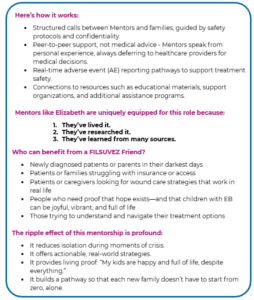
How to Connect with a FILSUVEZ Friend Mentor
Families can connect with a Mentor through the FILSUVEZ Friends website, via the program’s dedicated phone line, or through a direct link provided in program materials and partner websites like Patient Worthy. If you are interested in speaking with a Mentor, please click here or ask your healthcare provider about the FILSUVEZ Friends Mentor program.
The Mentor Generation Heals Itself
Looking back, Elizabeth is clear, EB has reshaped every corner of her life.
“It has changed everything. I am more empathetic, determined and hopeful. I didn’t know I could handle as much as I can, but even I doubt that in this journey. My priorities have changed but my perspective on life, love and its meaning has widened. It’s like I’ve been able to see beyond the veil.”
Peer mentorship, she believes, fills a space medicine simply cannot. Doctors treat the disease; mentors help the whole person. Knowledge can inform, but it is connection that softens the loneliness.
Lived experience carries an authority that no textbook can match. And when that experience is shared, when pain is transformed into purpose, it breaks the cycle of isolation for the next family.
By formalizing her role through the FILSUVEZ Friends Mentor program, Elizabeth has taken her own uncertainty and turned it into motivation. Each call she takes is a quiet act of rebellion against the loneliness she once felt. Each family she supports becomes part of a growing circle of resilience.
For anyone reading this who is navigating a new diagnosis or feeling swallowed by isolation, the message is simple and steady:
There are people like Elizabeth waiting to help.
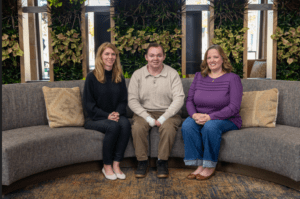 Your experience, no matter how painful now. may one day become your superpower.
You do not have to figure this out alone.
“If you were on the other end of my call,” Elizabeth would tell you, “I would say this:
‘I’m here for you. You can do hard things. EB is awful, but it’s something they have, it’s not who they are, and it cannot define who they will be. Joy is abundant, and so is determination.’”

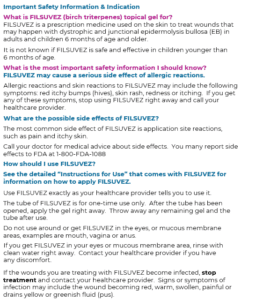
Please see full Product Information and Patient Information.