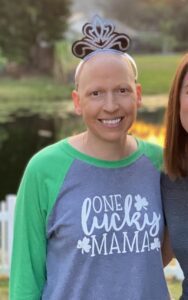
 The questions I get asked the most are “How did it start?” “Did you have any symptoms?” “How did they find it?” For five years before my life-altering diagnosis, my body had been sending subtle signals like persistent back pain, headaches and relentless fatigue. At the time, I wondered why other moms could hold their babies for hours, but it pained me to do so.
During the Spring of 2020, I was 34 years old, working from home as a full-time teacher. My daughters were 4 years old and 8 months at the time, and I remember being so exhausted. We were new to the Tampa area, and I had finally gotten around to scheduling my annual physical and routine bloodwork. About a week later, I was in the kitchen making my older daughter a snack when I got a call. The results were back and I immediately felt my body tense.
Apparently, I was anemic, and I can’t tell you how relieved I was to hear it wasn’t something worse. Little did I know that after a few more rounds of bloodwork and tests, I would be diagnosed with multiple myeloma.
My family and I were on vacation at my parent’s house that summer when I first heard the nurse say my blood results were out of range and there was a small chance I could have multiple myeloma. I spent the whole trip researching what multiple myeloma was and panicking. Everything I read was discouraging. The average life expectancy was measured in months, not years. Worst of all, it was incurable.
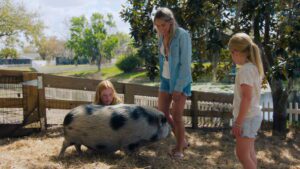
“All I cared about was my daughters.”
A few weeks later, I was back at school (work!) for meetings when I got the call from the nurse suggesting I make an appointment with a hematologist oncologist. I knew an “oncologist” treated cancer. The whole world was suddenly different, and I couldn’t concentrate. I left that day not knowing it would be my last as a full-time teacher after an 11-year career.
All I cared about was my daughters. They were so young, and I knew this diagnosis would shape their childhood. Make it less joyful, less carefree. It was my biggest fear.
I received an official diagnosis of multiple myeloma the day after my oldest daughter’s fifth birthday. The doctor told me it was rare for someone my age. Not only did I have an incurable cancer typically seen in patients 65 and older, it was in the latest stage and I needed treatment immediately.
And so began my quest to find the best care possible. I was given two to three more years, and I was willing to go through anything and everything to get more time with my family. Finding an appropriate treatment for me was the first glimmer of hope I’d had in a while. The only catch: I would be in Arkansas for the whole year.
In the weeks leading up to leaving, I began to withdraw from friends and family. I couldn’t bear to hear about someone’s day-to-day happenings, what their kids did that morning or the funny thing that happened at work. Intrusive thoughts were overwhelming, limiting my ability to do even simple things, like packing lunches. My mind was often consumed by doom and gloom, convinced I wouldn’t see 40 – wouldn’t witness countless future moments with my daughters – I couldn’t relate to anyone around me anymore, except my husband, who felt everything I was going through and more.
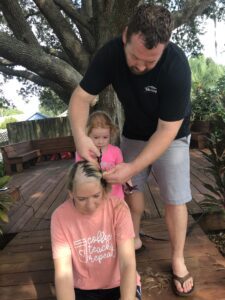 Despite this, it was my friends and family who jumped in to help when I left for treatment. My parents watched over my daughters while I was away. When I finally returned home, friends came over each night to lift my youngest into her crib when my husband was working late, and I couldn’t. To this day, my mom attends school events when I’m too unwell. Motherhood offers no days off, and I’m eternally grateful for the village that rallied around us.
Living with so much uncertainty forces you to make every day count. I live more fully, more spontaneously than the “old me” ever would have. Old me would never have allowed my daughters to miss a day of school. Now, once a year, we have “Mommy and Me” days. Each girl gets a day off, just for us, to do something special. School isn’t the most important thing anymore; making memories, spending time together, that’s what truly matters. I didn’t think I’d see my youngest’s first day of school, but I walked her into kindergarten. Those moments, once taken for granted, now mean infinitely more.
I started to share my story because when I was diagnosed, finding someone my age with this disease felt like finding a unicorn. First through my blog, then through the Multiple Myeloma Research Foundation and now through Bristol Myers Squibb’s Survivorship Today, an initiative aimed at sharing stories of individuals affected by cancer and advancing our collective understanding of what it’s like to live with the disease. I hope that in sharing my journey I can be that unicorn for others.
Living with an uncertain future has taught me to take a step back and maximize our happy times together as a family, to laugh until our sides hurt. Because, as it turns out, laughter truly is the best medicine.
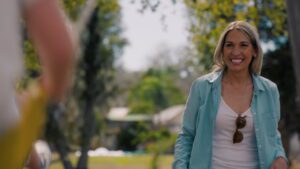 About the Author: Corinne Torney is a devoted mother of two and an elementary school teacher who is living with multiple myeloma. Diagnosed at 34 with an aggressive form of the disease, Corinne faced the immense challenge of undergoing treatment states away from her young daughters. While her initial prognosis was grim, she is now in remission and living with newfound hope.
Corinne’s goal in sharing her journey is to raise awareness of multiple myeloma and empower newly diagnosed patients to embrace the unknown. Corinne is an advocate in the cancer community, and proud ambassador of Bristol Myers Squibb’s Survivorship Today initiative.