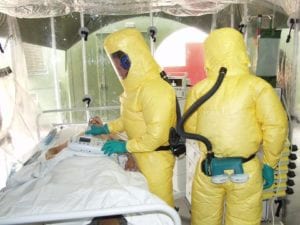

According to STAT News, a major international clinical trial is about to begin in the Democratic Republic of the Congo (DRC) as health authorities respond to a rapidly escalating outbreak of Bundibugyo ebolavirus, a relatively rare strain of Ebola. The effort aims to assess the effectiveness of two investigational therapies—remdesivir, an antiviral developed by Gilead Sciences, and MBP-134, a monoclonal antibody produced by MappBio—either as standalone treatments or in combination.
Rising Case Counts Prompt Urgent Action
The outbreak, now among the largest recorded for this virus species, has surpassed 1,100 confirmed cases in the DRC, with hundreds of deaths reported. Transmission is concentrated in the country’s northeastern region, where prolonged instability, population displacement, and shortages of food and health infrastructure complicate containment efforts. Neighboring Uganda has also reported imported cases and limited onward transmission.
Trial Design and Objectives
The study—coordinated by the World Health Organization (WHO) and a consortium of international partners—will involve approximately 1,000 participants. Researchers aim to determine whether either investigational therapy improves patient outcomes and whether a combination approach offers added benefit.
Participants will be randomly assigned to one of four groups:
- Remdesivir alone
- MBP-134 alone
- A combination of both drugs
- Supportive care only (current standard treatment)
The inclusion of a control group receiving supportive care is intended to provide a clear benchmark for assessing treatment efficacy.
Scientific and Logistical Challenges
Bundibugyo ebolavirus remains poorly understood, with only two prior outbreaks documented since its identification in 2007. Unlike more common Ebola strains, this variant may produce less severe illness in some individuals, potentially lowering overall mortality rates. While this could be encouraging from a clinical standpoint, it presents a challenge for researchers, as detecting statistically significant treatment effects may require a larger study population.
Another complication is the absence of proven vaccines or therapeutics targeting this strain. Although MBP-134 has shown promise in preclinical and early clinical work, its use in this trial will focus solely on treatment rather than prevention. Researchers also note that while the monoclonal antibody could theoretically serve as a prophylactic, that application will not be investigated at this stage.
Global Collaboration
The trial is being conducted through a broad partnership that includes the DRC’s National Institute of Biomedical Research, the University of Oxford, and several non-governmental organizations operating Ebola treatment centers, such as ALIMA, Médecins Sans Frontières, and Samaritan’s Purse. The United States government, through the Biomedical Advanced Research and Development Authority (BARDA), has funded the development of MBP-134 and is supplying doses for the study.
Looking Ahead
Health officials emphasize that results from the trial will be critical in shaping the response to this outbreak and improving preparedness for future ones. With the epidemic continuing to expand and limited treatment options available, the findings could help establish the first evidence-based therapies for this rare Ebola species and inform strategies for managing similar outbreaks in the future.
-300x300.jpg)