
Editor’s Note: Patient Worthy is honored to share this interview, featuring Kate, an ovarian cancer survivor, and Dr. Premal Thaker, M.D.
“There is fear, and there are hard days, but there is also support, connection, treatment, and hope.”
Kate– Ovarian cancer is notoriously sneaky. Looking back, what were your very first symptoms, that you attributed to the fatigue or the stress of running a business and family life?
“Looking back, my first (and only) symptoms were digestive issues. For at least 1-2 months I was constipated, bloated, and very uncomfortable, but I still had energy. I took over-the-counter medication to try to help and put the symptoms aside, attributing them to personal-related stress, given that at the time my son was experiencing medical issues that took a physical and emotional toll on our whole family. There was nothing in my mind that said, “This could be cancer.” But then the bloating became the biggest warning sign that something was seriously wrong. I visited my primary care physician and got a CT scan, which confirmed that I had ovarian cancer.
My experience has taught me the incredible importance of symptom awareness. Ovarian cancer symptoms can be easy to dismiss because they seem like things that women deal with all the time (bloating, constipation, stomach issues, discomfort). But for me, those digestive symptoms were the only real signs.”
Dr. Thaker – Since symptoms might arise from many causes, what guidance can you give people to help them know when they should pursue more testing?
“Unfortunately, there has not been much progress in developing comprehensive screening tests that are both accessible and effective in detecting ovarian cancer in earlier stages. As a result, about 80% of women with ovarian cancer are diagnosed in advanced stages, usually stage III or IV, when the cancer has spread beyond the ovaries into areas such as the upper abdomen, lymph nodes, or the chest. My biggest piece of advice to women is to always pay close attention to changes in your body and bring up any concerns with your primary care doctor or gynecologist as soon as possible.
Ovarian cancer is difficult to diagnose because symptoms are often vague or easily misdiagnosed as conditions such as IBS or ovarian cysts. Symptoms that may indicate ovarian cancer to be aware of include unexplained bloating, changes in urination, pelvic or abdominal pain, or trouble eating or feeling full quickly. It is essential that women pay attention to these types of changes in their bodies, particularly if symptoms are consistent or worsen over several weeks. Generally, if symptoms do not resolve within two weeks, we recommend pursuing testing such as a transvaginal or transabdominal pelvic ultrasound or a CA-125 protein blood test to learn more.
Ovarian cancer also has a strong genetic component. In cases where there may be a family history, genetic testing can reveal any mutations such as in the BRCA1 and BRCA2 genes and thus if women are predisposed to gynecological cancers like ovarian cancer.”
Kate – When you became convinced that something might be seriously wrong, did you encounter any push back from your providers in terms of obtaining further testing?
“No – in fact, I feel incredibly fortunate because the provider I saw took my symptoms seriously. I went to my primary care doctor’s office and saw a physician’s assistant. As I explained my symptoms, she decided to order a CT scan. That CT scan is what changed everything.
From there, things moved very quickly. But every step of the way, I have felt supported by my care team and am especially grateful to Dr. Thaker. She has helped me a lot, explaining my treatment plan in detail and taking everything step by step. She helps me stay in the moment rather than letting my mind wander about what ifs. Having Dr. Thaker as my oncologist and surgeon has been the biggest gift.
I also became incredibly close and still stay in touch with the nurse who helped with my stomach draining to ease my bloating. It was an outpatient procedure, and I was very scared as I heard it was painful. She was amazing. During the procedure, she showed me her screen so I could see what she was seeing, explained everything she was doing, and talked to me through the painful parts as a distraction. This communication is exactly what I needed to ease my worries. Since then, we have become good friends. This goes to show the power of having an incredible care team in making the process just a little bit easier.”
Dr. Thaker – What words might be most effective in convincing a doctor to move forward with advanced scanning or biopsies?
“A family history of ovarian cancer or genetic testing showing BRCA1 or BRCA2 mutations is critically important information to share with your doctor if you are experiencing concerning symptoms and valid reasons for doctors to pursue advanced diagnostic approaches such as imaging tests or biopsies.
I think as women we often downplay problems with our physical health, which can potentially lead to misdiagnosis or disease progression. Each of us knows our body best. Follow your intuition, be proactive in voicing concerns with your doctor, and seek multiple opinions, if needed. To effectively advocate for advanced testing, be clear, persistent, and specific. Describe what symptoms you are experiencing and how often. Highlight what symptoms are new and if they are not resolving. Emphasize any known genetic factors or family history of cancer. Request specific initial screenings, which can help doctors understand your level of concern. For example, “Could we consider an ultrasound?” It can be helpful to go into doctor’s appointments prepared with a list of questions or notes to make sure you cover everything that is on your mind and important to address.”
Kate – It takes grit to run a small business, and energy. When you received your diagnosis, what was it like to have to pivot and rely heavily on others to keep both work and home going while you dealt with scans, chemo, and uncertainty?
“My cancer diagnosis felt isolating at times, but I have also had positive experiences from it in a lot of ways. My son and I have co-owned a bakery/café as well as a full-service restaurant for the past 20 years. I am very involved, helping to oversee the bakery/café and handle all administrative duties.
When I was diagnosed, there was no other choice but to focus on my cancer journey. It became my new job. Letting go of responsibilities and the ability to support my staff was not a choice, it was a new way of life. Priorities changed overnight. Tests, appointments, chemotherapy, surgery, and recovery became my new normal.
My husband, sons, family, and friends were with me every step of the way and continue to support me each and every day. My staff took over and worked so hard to keep things running smoothly in my absence. Cards, notes, gifts, and prayers poured in from our customers. It was powerful.
Now I am back at work every day. I do administrative work from home, go in for lunch service, and come home later in the afternoon. As I continue to heal while I am on chemo medication in pill form, I notice I am more tired, my energy is still not 100%, and things ache a bit more than before my diagnosis, but I am back! Not a day goes by without customers asking, “How are you? It’s so good to see you are back! You look great! Love your short hair!” I hope they never stop inquiring. I continue this journey and I’m glad to have the opportunity to share with all the thoughtful people who continue to ask. In turn, I hear countless stories of cancer from those people. So many share this path. It’s healing for me to listen and let others share.”
Dr. Thaker – When you consider the treatment protocol, and its side effects, what advice do you have for patients facing it and balancing the need for treatment, with quality-of-life concerns? Did you have to make adjustments such as lowering a dose or delaying a treatment?
“Each person and case is different, and thus not everyone will have the same treatment protocol. For gynecologic oncologists, while the stage and histology of each tumor is our focus, we consider each ovarian cancer case with scrutiny, care, and urgency. We are your surgeons and medical oncologists offering chemotherapies and targeted therapies, and, most importantly, your team. When considering a treatment protocol, especially the potential side effects of chemotherapy, I advise patients to think about their goals of therapy (i.e., curative vs. palliative) and preferred quality of life and design treatment around that. I believe we should take as much time as needed to give patients optimal, individualized care and move at their own pace, step by step.
Patients should consider whether they prefer to manage symptoms or pursue more rigorous treatment that may come with significant side effects like hair loss, neuropathy or a weakened immune system, any milestones they hope to see with family or friends, as well as any financial, lifestyle, cultural or familial concerns. All this information helps us to decide which treatments are most appropriate.
The one thing that remains consistent – no matter what stage of cancer, we encourage patients to have honest conversations with their care team and never stop asking questions about side effects or what their future may look like throughout the treatment process.”
Kate – Have you undergone genetic testing to see if you have any known genomic risks?
“I did. No risks were found.”
Kate – What message do you have for other women?
“The message I would shout is hope. I was diagnosed with stage 4 ovarian cancer at age 68 and it is amazing to me that I was so sick and still responded so well to treatment. Chemotherapy was hard, but it saved my life. Science has come so far, and there are so many resources now.
I would also tell women not to ignore symptoms that feel different or persistent. Bloating, constipation, stomach discomfort — those issues can seem ordinary, but they can also be signs that something more serious is going on. If something does not feel right, speak up and keep asking questions.
And if you are facing an ovarian cancer diagnosis, know that you are not alone. There is fear, and there are hard days, but there is also support, connection, treatment, and hope.”
Dr. Thaker – What would you like to see happen in the future in terms of ovarian cancer prevention, testing, treatment?
“For any type of cancer, a cure is the holy grail. Clinical trials of new and innovative therapies are key for the ovarian cancer community to get there in the future. I am proud to be part of promising clinical trials advancing frontline therapeutic options for ovarian cancer — a treatment area that has not seen meaningful advances for approximately the last 30 years.
Platinum and taxane-based chemotherapy is the current standard of care treatment for ovarian cancer. However, it is associated with serious side effects. There is an urgent need for effective and safer therapies that can reduce or eliminate the risk of side effects often seen with chemotherapy to help improve women’s quality of life and survival outcomes, as well as prevent the risk of disease recurrence. Currently, clinical research assessing the combination of novel immunotherapy approaches with standard of care chemotherapy has demonstrated incredible survival benefits and safety results and offer women and the scientific community real hope for the future.
With advances in new potential treatment options, this often prompts the development of new diagnostics and screening methods. I am hopeful that we will see advanced diagnostics emerge to help detect ovarian cancer earlier when women have more curative therapies.”
Both Kate and Dr. Thaker– What gives you the most hope right now regarding new treatments, clinical trials, or targeted therapies for advanced ovarian cancer?
Kate — “What gives me the most hope is knowing that doctors and researchers are still pushing forward to find better options for women with ovarian cancer. Through my own treatment, I have seen how far science and medicine have come.
Also, knowing that Dr. Thaker and her team are participating in clinical trials for new promising treatments gives me hope, not just for me, but for other women who will be diagnosed with ovarian cancer in the future, that they may have more and better treatment options. With ovarian cancer, there is always some fear about what could happen next, so the fact that research is continuing means everything.”
Dr. Thaker — “One clinical trial, which I am the Chair of, is the OVATION 2 Study assessing a novel immunotherapy called IMNN-001 in combination with standard of care neoadjuvant chemotherapy for the treatment of advanced ovarian cancer patients. This therapy IMNN-001 by IMUNON has a unique design where it allows us to administer IL-12 to the tumor microenvironment and avoid all the systemic effects that had been seen previously from recombinant humanized IL-12.
Results from the Phase 2 study are very encouraging, indicating that treatment was associated with an overall survival benefit of more than a year, and more than two years in women also receiving PARP inhibitors as part of maintenance therapy. Importantly, this investigational therapy continues to maintain a highly favorable safety and tolerability profile, further reinforcing its potential to represent a landmark advance in treatment for women who are in desperate need of new and improved treatment options. I am pleased to be involved in the Phase 3 study of this therapy (OVATION 3) and support its clinical development to further validate its safety and efficacy.
I believe that oncologists are the ultimate optimists. Studies like these aiming to revolutionize the future of cancer care by focusing on changing the local tumor microenvironment with immunotherapy and innovative delivery strategies are cause for optimism.”
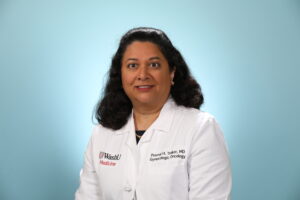 About Dr. Thaker: Premal H. Thaker, M.D., is Chief of Gynecologic Oncology, David & Lynn Mutch Distinguished Professor of Obstetrics & Gynecology, Director of Gynecologic Oncology Clinical Research at Washington University School of Medicine, OVATION 2 Study Chair and Study Chair of Phase 3 OVATION 3 trial.
Dr. Thaker earned her undergraduate degree in biology from Villanova University and her medical degree from Allegheny University of the Health Sciences in a combined BA/MD program. She completed her residency in Obstetrics and Gynecology at the Hospital of the University of Pennsylvania and her fellowship in Gynecologic Oncology at the University of Texas MD Anderson Cancer Center. She also holds a Master’s degree in cancer biology from the University of Texas Graduate School of Biomedical Sciences and received training in laparoscopic lymph node dissection at Charité – Universitätsmedizin Berlin in Germany. Dr. Thaker has been inducted into both the American Gynecological & Obstetrical Society and the Society of Pelvic Surgeons.