Editor’s Note: Patient Worthy is honored to share the following article, originally published by our friends at CURE SYNGAP1. To see the article in its original format, please click here.

5 years old
Connecticut, USA
Warrior #228
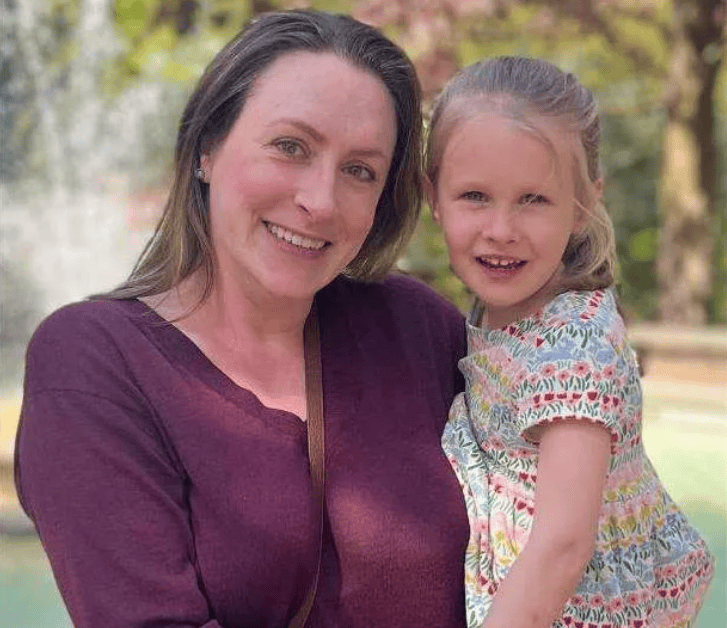
Lorelei is our five-year-old girl who greets the world with motion—running, biking, climbing, dancing—and with a curiosity that pulls her toward adventure. Whether she’s chasing a soccer ball, splashing in the pool, or zipping down the playground slide, Lorelei meets each day with an open heart and boundless energy.
Her early life looked much like any other. She met her milestones, and as a baby she was busy and alert, though plagued by frequent ear infections. When her language began to lag around 18 months, our pediatrician reassured us that it was temporary—that once the infections stopped, her words would come. Ear tubes did their job, but her language didn’t catch up. Slowly, other signs appeared: head banging, night terrors, intense meltdowns that felt overwhelming for our whole family. Lorelei was constantly in motion, highly distractible, and drawn to repetitive play—opening and closing doors, watching wheels spin, running off whenever she could.
At age three, she was referred to speech therapy and occupational therapy. After working with Lorelei for just a few weeks, her speech therapist gently told us that Lorelei would likely need intensive behavioral support to make progress. That was the moment we entered a world we hadn’t known existed. After further evaluations, Lorelei was diagnosed with Autism. Genetic testing was suggested, and a few months later, in February 2024, the results came back: SYNGAP1-Related Disorders.
That summer, we sat in a genetics office trying to absorb yet another diagnosis. The doctor explained the risks—seizures, intellectual disability, low muscle tone, and more—and when I asked what Lorelei’s future might look like, she responded casually, “Well, she won’t be getting her Ph.D.”
Her words struck me with stunning force; not for what they said about a college degree, but because of how easily a stranger had placed limits on my child. I gathered our things, scooped my baby into my arms, and cried in the car while Lorelei happily flipped through a book, utterly unaware that anyone had tried to define her future.

Later that day, at home on a warm summer afternoon, Lorelei asked to “do bubbish” in the front yard. As bubbles floated around her and she studied blades of grass with intense focus, I searched for answers. One word—SYNGAP1—led me to the CURE SYNGAP1 (fka SynGAP Research Fund) community. Within minutes of joining, someone reached out. Then another family. By the next morning, I had a meet-up planned with another Connecticut SYNGAP family who understood exactly what we were carrying after a devastating diagnosis.
That immediate sense of connection and community is what kept me from spiraling—and it continues to carry us forward.
Lorelei’s seizures began shortly after she turned five. She also navigates sensory challenges every day—wet hair, brushing teeth, lotion on her skin—but she is learning, bravely and steadily, to tolerate what once felt impossible. She started Kindergarten in September 2025, loves school, and riding the bus is one of her greatest joys. While her attention span is shorter than that of her peers, movement helps her regulate, and a sensory diet at school supports her need to be active. Adaptive gymnastics has become a place where she builds balance, confidence, and patience—learning how to wait her turn while still being fully herself.
At home, Lorelei is our one and only. She adores our two cats, especially our fifteen-year-old cat Maisy, who has reluctantly accepted her role as a therapy cat. Lorelei finds comfort in Maisy’s deep, steady purr, and we find the two of them cuddling on the couch often. While cooperative play with peers is still a work in progress, Lorelei loves being around other children and learns so much by spending time with her general education classmates.

Some of Lorelei’s biggest challenges right now are visual processing and dyspraxia, which make drawing shapes, tracing letters, and participating in certain school activities difficult. But her joys shine just as brightly. When she plays independently, we often hear her most complex language—six- and seven-word sentences, little stories she invents on her own. She loves to sing, creating her own versions of familiar songs, and she has a growing love of learning. She’s working on sounding out CVC words and reading simple sentences, proudly showing us each new skill.
Lorelei has recently fallen in love with the moon. No matter the season—even on the coldest winter nights—we head outside for a family “moon walk.” Watching her search the sky, spot the moon, and dance beneath the stars reminds us what joy can look like when you’re fully present in the world.
As a family, we’ve learned to let go of expectations that don’t serve her. There are so many unknowns with a rare genetic disorder, but we refuse to let fear shape our days. Instead, we focus on what brings Lorelei joy, on advocating fiercely for her, and on being actively involved with CURE SYNGAP1, pushing forward with hope and purpose.
We believe our daughter is perfect exactly as she is. She experiences joy in ways that teach us how to slow down and truly see the world. Still, our greatest hope is for a cure—one that would give Lorelei the best chance at independence, fulfillment, and the ability to care for herself when we no longer can.
If there is one thing we would tell other families walking a similar path, it’s this: find your people, the ones who love your child and lift you up—and never let anyone place limits on your child’s potential. Lorelei is not defined by her diagnosis. She is a warrior, a moon-walker, the sweetest cuddle bug, and a bright light guiding us forward, one joyful step at a time.