Editor’s Note: The following story was originally written and shared with us by Holly M. LaPrade.
Thirty years ago, a small army of doctors cautiously presented me with a sheet of scrap paper. In typical medical provider fashion, the handwritten script on the document was essentially illegible. I focused on the hastily scribbled words, seeing a numbered list of seven medical conditions that were not familiar to me creeping across the page. Several of the terms appeared to be written in Latin, as I quickly scanned to the last item on the list: Fibrodysplasia Ossificans Progressiva.
The good news was; I did not have cancer. I had prepared for that pathway over the past few days, but thankfully that was no longer my diagnosis. The friendly faces in front of me appeared to be puzzled. They explained that while I did not have cancer, I did – in fact – most likely – probably – have one of the conditions on this ominous list that was being presented to my sixteen-year-old self.
It turned out to be the “last but not least” item on the list – the lengthy, uncomprehensible Latin term that they kindly shortened to “FOP,” for ease of pronunciation. Never mind that my entire world had been turned upside down at that moment. FOP was easy to pronounce, and it wasn’t a death sentence. I was ready to break free from this hospital bed and move on with the rest of my life.
Prior to my diagnosis, I was experiencing all of the joys of being a teenager. I had just received my driver’s license, started my first part-time job, joined my high school basketball team, and I had a pretty cool boyfriend (who later turned out to be a jerk, but that’s a story for a different day).
On the night my Mom took me to the Emergency Room, I had a babysitting job and initially resisted her request to take me to the hospital. Despite the gravity of the situation at hand; I just wanted to live my life, and I didn’t want a diagnosis to get in the way of that mission.
Shortly after I joined the basketball team, I began to experience stiffness and loss of mobility in both of my shoulders, as well as my neck and back. My friend noticed that my neck was very stiff, and I was unable to fully turn it from side to side. I also noticed that I could no longer lift either one of my arms up over my head. There were 7 distinct areas on my body that appeared to be tumors.
My Mom took me to the hospital, and I was misdiagnosed with Non-Hodgkins Lymphoma. I underwent a series of tests, met with an oncologist, and was prepared to begin chemotherapy. A biopsy was eventually done, and it revealed that I actually did not have cancer. The doctors were still unsure what condition I had and presented us with the previously mentioned list of “possible” conditions. After a week at the hospital, I was correctly diagnosed with FOP.
In order to come to the diagnosis, there were several tests conducted that could have worsened my condition, as they are considered traumatic to a person with FOP. These included the biopsy, the insertion of a catheter to receive chemotherapy, and a spinal tap.
The primary reason that my community works so hard to raise awareness of FOP is because these types of trauma need to be avoided at all costs in FOP patients. FOP can correctly be diagnosed simply by looking at the patient’s toes, as the majority of patients have a malformed or missing big toe.
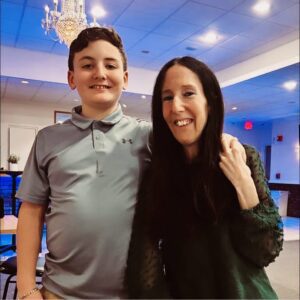 The biggest challenge of living with my diagnosis is the fact that it is so rare, and that can be isolating. It can be difficult for others to understand the challenges that rare disease patients face in their daily lives. FOP affects me physically, but it also impacts me mentally and emotionally. On my hardest days, those challenges can combine into a struggle that is hard to put into words.
My best advice is to simply take one day at a time, when faced with any challenge in life. Living with FOP has certainly been daunting at times, but I am grateful for all of the positive aspects of my life that make it worth living.