About Dravet Syndrome
Dravet syndrome—a rare, genetically-based disorder also known as Severe Myoclonic Epilepsy of Infancy—is characterized by epileptic seizures that begin within the first year of life, along with a range of comorbidities that typically emerge later, such as cognitive impairment, behavioral issues, sleep disturbances, motor and speech function deficits, and autism spectrum disorder. The mortality rate is high, reaching 15% before adulthood, primarily due to sudden unexpected death in epilepsy (SUDEP). It is caused by a mutation in the SCN1A gene and begins to manifest during the first year of life.
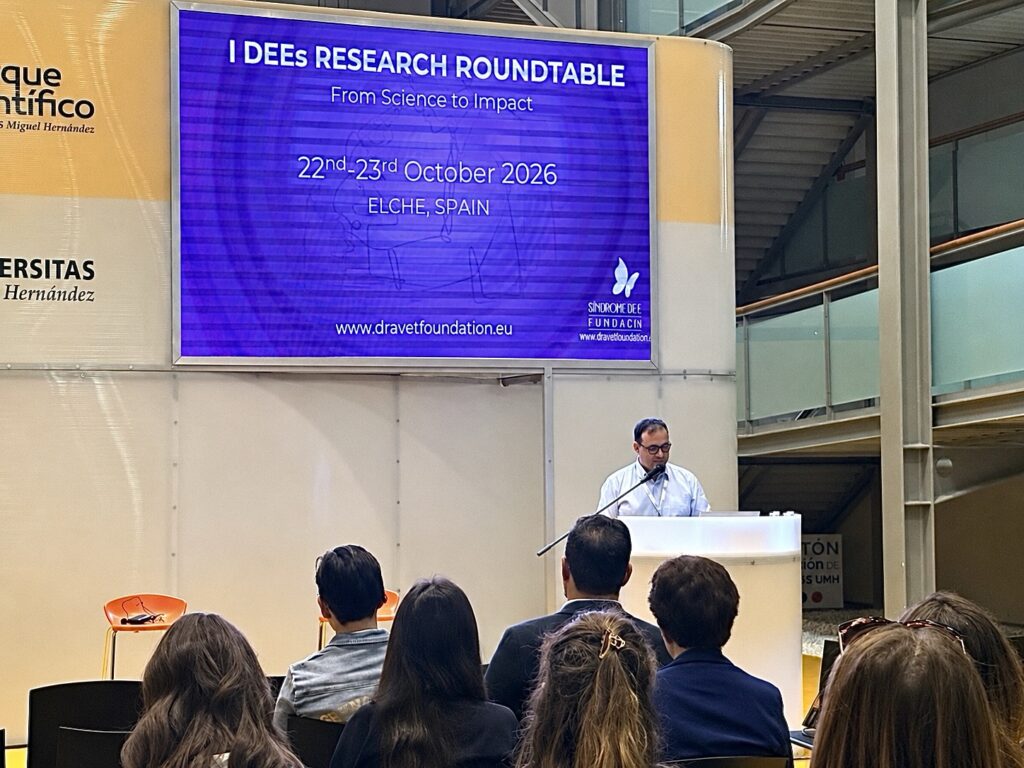
The Dravet Syndrome Foundation of Spain organized an International I DEEs Research Roundtable, a scientific event that brought together international experts on epileptic and developmental encephalopathies.
Stéphane Auvin (Robert Debré University Hospital, Paris) opened the meeting with a video presentation reviewing clinical trials for early-onset epileptic encephalopathies (EEEs). These trials have led to the approval of treatments for Dravet and Lennox-Gastaut syndromes, and a new generation of precision and disease-modifying therapies is now emerging. However, Auvin noted that significant gaps remain: the need for validated measures for comorbidities beyond seizures—such as cognitive delay, behavioral issues, sleep disturbances, and quality of life—as well as challenges in recruiting from small, heterogeneous, and geographically dispersed populations, and the need for greater involvement from families in defining which clinical outcomes are truly meaningful.
José Ángel Aibar, president of the Dravet Syndrome Foundation, provided the patients’ perspective. He argued that the primary shortcoming is not a lack of new molecules, but rather how clinical trials are designed, who is included, and what is measured. “Families bear much of the burden of clinical trials, yet these trials focus on seizure counts while overlooking what families value most—such as communication, behavior, and cognition,” he noted. Aibar proposed six actions: a core set of comorbidities developed in collaboration with families; protocols that account for the burden of participation; trials that span the entire lifespan; faster pathways from diagnosis to clinical trial; patient ownership of their own data; and post-trial commitments explicitly included in the protocols.
A round table featuring Alexis Arzimanoglou (Sant Joan de Déu Hospital, Barcelona), Alba Sierra Marcos (Hospital de la Santa Creu i Sant Pau, Barcelona), and José Ángel Aibar explored how to design clinical trials that align with the realities of developmental and epileptic encephalopathies (DEEs). Subsequently, Ovid Therapeutics, Servier, Xenon Pharmaceuticals, and Jazz Pharmaceuticals shared updates on their respective development programs. The day concluded with group sessions focused on trial design and feasibility, the use of real-world evidence, trial preparedness, and early intervention.
From Evidence to Patient Impact
On the second day, Simona Balestrini (Meyer Children’s Hospital IRCCS, Florence) and Elena Gardella (Danish Epilepsy Centre Filadelfia, Dianalund) discussed the role of genetics and precision medicine. The key takeaway is that clinical assessment must take precedence, with genetics serving as a complementary tool; however, a precise understanding of each variant—supported by in-depth phenotyping and genotyping—is considered essential for selecting patients for clinical trials and advanced therapies, ultimately improving their quality of life.
A round table featuring Robert Pleticha (Admedicum), Hannah Stamberger (Antwerp University Hospital / VIB-UAntwerp), and Cristina Ruedell Reschke (RCSI & FutureNeuro, Dublin) emphasized that families should be involved in all phases of clinical research, including the presentation and discussion of results. The speakers also called for multi-center registries and validated questionnaires that cover various early-onset epileptic and developmental encephalopathies (EEDs) and are available in multiple languages, ensuring they can be used in any country.
Priorities for the next 12 to 24 months
Alexis Arzimanoglou concluded the meeting by outlining priorities for the next two years: leveraging existing natural history studies rather than starting from scratch, deepening the understanding of disease mechanisms, moving toward preventive clinical trials, and relying on networks, registries, and consortia with experience in clinical trials. He also referred to the HLM4Rare initiative and its vision of “health without postal codes,” noting that since the list of potential priorities is endless, they must be ranked by importance.
For the Dravet Syndrome Foundation, “the meeting has shown that it is possible to bring clinicians, families, researchers, and the industry to the same table to design clinical trials that address what truly matters to patients. Our commitment is to turn these conclusions into concrete actions,” stated José Ángel Aibar, president of the organization.
The Foundation will compile the meeting’s conclusions and priorities into a report and will continue the work initiated within the various working groups.