Editor’s Note: Patient Worthy is honored to share this caregiver story, originally written by Jennifer Mack, Director of Development & Community Outreach for the 16p11.2 Genetic Foundation.
When the Answers Wouldn’t Come
Jennifer had an uneventful first pregnancy with son Xander who made it all the way to 40 weeks.
Then there was meconium in the amniotic fluid, and some of it made its way into his lungs. She knew of other babies who had gone through something similar and gone home the next day.
Xander stayed for 16 days.
Even then, he left the hospital with traces still in his lungs. Not long after, he was back in the hospital and needed steroid treatment while struggling to coordinate eating and breathing. He was diagnosed with failure to thrive, something that feels almost surreal to Jennifer now, given the very different metabolic and weight challenges he would face later.
Then came pyloric stenosis.
Xander was spitting up everything he took in, at every feeding. When Jennifer would call with concerns, she was told he was probably fine and that she was just a first-time mom.
Twenty-four hours later, she held him as he cried on his third day without food.
He was six weeks old and waiting for surgery.
Later, when his development and speech looked different from those of other children his age, she heard another version of the same dismissal: “Boys talk late.”
She kept asking questions anyway.
 The Diagnosis Came Early. Understanding Took Longer.
 The Diagnosis Came Early. Understanding Took Longer.
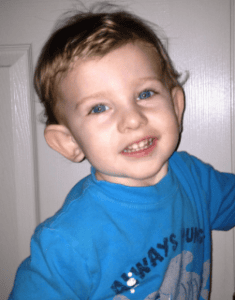
Xander received his 16p11.2 deletion diagnosis at age 3.
Over the years, he accumulated more than 25 diagnoses and significant clinical findings. Specialists looked at individual pieces, but Jennifer was still trying to understand the whole child.
She learned having a diagnosis and understanding a diagnosis are two very different things.
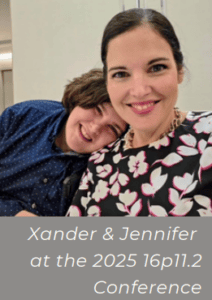 Finding the 16p11.2 Genetic Foundation changed that for her. She attended the conference in October 2025, and by the end of it, she felt a renewed sense of purpose. She could see the vision Dr. Faranak “Franki” Herrera and the team were building, and she knew she wanted to be part of it.
Franki could take what researchers were learning about 16p11.2, translate it into language that families could understand, and thereby help Jennifer see how that science might apply to the child in front of her.
Suddenly, she could recognize patterns and ask better questions. She had a clearer picture of why certain things might be happening and how to advocate for Xander as a whole person, rather than as a collection of separate diagnoses.
Franki also changed the way she thought about intervention.
Over the years, Xander has participated in speech therapy, occupational therapy, physical therapy, myofunctional therapy, brain training, and more. As he got older, some of those supports began to trail off. It became easier to accept that school-based speech services could end or that OT might not identify a clear enough goal, especially when Xander was content spending much of his free time on a screen and had no interest in becoming a basketball star.
Franki challenged Jennifer not to let adolescence become the point when they quietly backed away.
Her explanation helped Jennifer understand something she had not fully appreciated before: Xander can absolutely keep learning and making progress, but acquiring new skills may take more repetition and effort for him. Meanwhile, the world around him keeps getting more complicated. His peers are building new academic, social, communication, motor, and independence skills at a rapid pace.
Instead of assuming Xander was done with therapies, Jennifer started asking where he might need more support.
That was one of the most practical gifts of understanding the science better. It changed what she was willing to accept as “good enough” for Xander and reminded her that being content does not mean he has reached his potential.
Families need research. They also need people who can help translate it into: “Here’s what this might mean for your child, and here’s what you may want to think about next.”
 Tenacity in Action
 Tenacity in Action
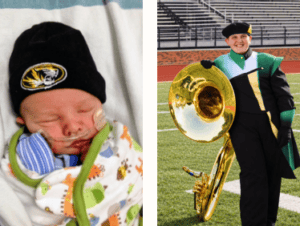
Jennifer often thinks about the distance between the newborn who spent weeks struggling to breathe and clear a lung infection and the teenager who now marches onto a football field carrying a tuba, an instrument that depends on breath control.
That still moves her.
Adaptation has characterized Xander’s whole life.
When people could not understand him, he found creative ways to reframe what he was trying to say. Before he could speak at all, that same determination showed up in the way he would climb, reach, and problem-solve his way to whatever he wanted.
One way or another, he kept going.
He has spent his life learning, adapting, practicing, and trying again. Jennifer sees some of her own determination reflected in him.
Finding a Place to Put It to Use
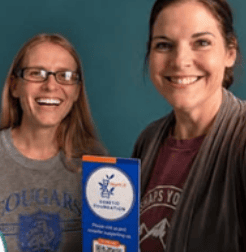 Jennifer now volunteers roughly 40 hours a week for the 16p11.2 Genetic Foundation while raising four children with significant medical and developmental needs.
She does it because Xander is proof that showing up, over and over, changes things.
This community gave her somewhere to put all those years of searching, questioning, learning, and advocating. Now, as Director of Development and Community Outreach, she uses those skills to help families find their footing, tell community stories, build awareness, develop partnerships, strengthen donor relationships, and invite people to invest in the mission.
She also gets to dream up ways to bring people in.
The Sweet 16 Club, the Foundation’s monthly giving community, and 16p11.2 Awareness Day on November 16 are two initiatives she is especially proud to have helped start. You’ll find out more about both below.
And she sees so much more the Foundation could do.
A Vision Bigger Than Our Resources
There are more families to reach, more stories to tell, more awareness to build, more partnerships to pursue, and more ways the Foundation could support this community with the resources to do it.
That is where help is needed.
The Foundation needs donors and monthly supporters. It needs partners and volunteers. It needs people who will share its work, make an introduction, open a door, or decide that this rare community is worth investing in.
Jennifer knows what it feels like to have a diagnosis in hand and still be trying to understand the child in front of her. She also knows what it feels like when someone finally helps the pieces make more sense.
She wants that understanding to be easier to find for the families coming after hers.
Every person who joins the Foundation gives it a little more capacity to make that happen.
What Xander Has Taught Jennifer
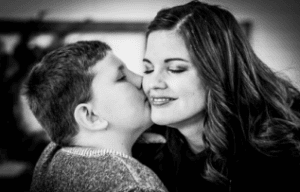 Xander has spent his life working extraordinarily hard to become who he is.
From the baby who struggled to breathe and eat to the teenager carrying a tuba onto a football field, his life has been an exercise in tenacity.
He inspires his mother to bring that same tenacity to what comes next for this community.