There are parts of 2024 that I know only through photographs and the stories my sister has told me.
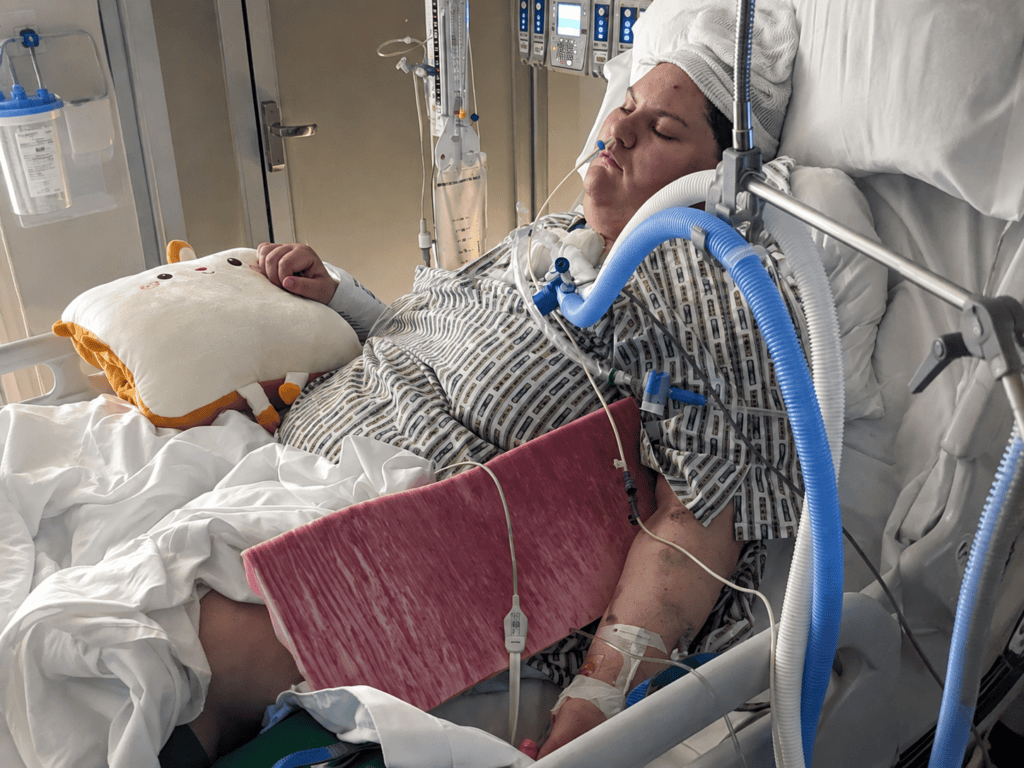
In some of the pictures, I am lying in a hospital bed surrounded by tubes, machines, IVs, and monitors. I look at them now and sometimes have a hard time believing that person is me.
Just weeks earlier, I had been living independently and building my career. I was thirty years old. Brain surgery, a tracheostomy, a feeding tube, and months of rehabilitation were nowhere in the future I had imagined for myself.
Everything started with symptoms that did not make sense. I was having problems with my balance, dizziness, and difficulty swallowing.
On June 29, 2024, I went to the hospital and learned that I had a brain tumor.
At first, all I really knew was that it was benign. I didn’t know what kind of tumor it was or how large it was. I was trying to process the words “brain tumor” without fully understanding what I was actually facing.
It wasn’t until July 8, the day before I was transferred from one hospital to another, that I learned the tumor was an acoustic neuroma, also called a vestibular schwannoma.
Even then, I still didn’t know its size.
It wasn’t until mid-July that I finally learned just how large it was. The tumor was approximately 4.5 centimeters and was compressing my brainstem.
Learning that changed everything. Until then, I knew something serious was happening, but I don’t think I understood how much my life was about to change.
Within weeks, I underwent multiple brain surgeries. I knew recovery would be difficult, but I could never have imagined what followed.
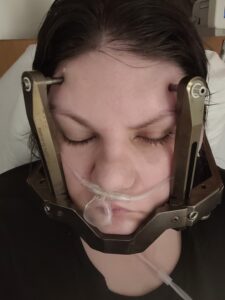 I developed aspiration pneumonia and respiratory failure, which led to dangerously low oxygen levels, or hypoxia. I needed a tracheostomy to breathe and a feeding tube because I could no longer safely eat. I also experienced serious complications, including infection and sepsis.
My world became hospital rooms, machines, procedures, and people doing things for me that I had always been able to do for myself.
Eventually, the immediate crisis passed, but getting through it did not mean I could simply get out of bed and return to my old life.
I had to rebuild basic abilities I had never imagined losing.
Walking became something I had to learn again. Eating became an accomplishment. Standing up and taking a few steps could represent weeks of work. Things I once did without thinking suddenly mattered enormously.
At the same time, I was learning to live with changes that weren’t going to disappear simply because I worked hard at rehabilitation.
I lost the hearing in my right ear and developed facial paralysis on the right side of my face. Losing the hearing in one ear changed the way I experience the world. Locating sounds became difficult. Conversations could be exhausting. Busy environments required a level of concentration I had never needed before.
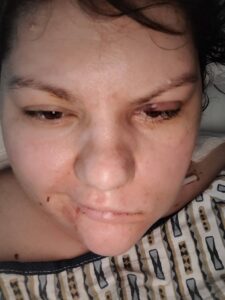 Facial paralysis affected me in a different way. Your face is such a large part of how you recognize yourself and how other people recognize you. I would look in the mirror and know it was me, but I didn’t always feel like the person looking back at me was the same person I remembered.
There was grief in that.
But there was also progress.
I spent months moving through hospitals and rehabilitation. Eventually, I could eat again. My feeding tube was removed. I became stronger. I kept working on walking and becoming more independent.
On December 16, 2024, after nearly six months away, I finally went home.
I had imagined that moment for so long. But once I was home, I realized something I hadn’t really understood before: going home does not automatically mean life goes back to normal.
Recovery came home with me.
There were appointments, therapy, scans, more procedures, good days, and difficult ones.
Because part of my tumor had to remain after surgery, I underwent Gamma Knife radiosurgery in June 2025 to treat the residual tumor. I have also undergone facial reanimation surgeries to try to restore movement to the right side of my face.
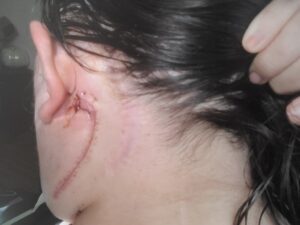
There have been improvements, but there has never been one moment when I could say, “I’m recovered now.”
Before this happened, I think I pictured recovery as a straight line. Something happens to you, you receive treatment, you get better, and eventually you move on.
I don’t see it that way anymore.
Recovery can mean being grateful for how far you’ve come while still grieving what you’ve lost. It can mean celebrating progress while admitting that some days are still hard. It can mean accepting that your life has changed while continuing to build a life within that change.
Over time, I started writing about what had happened to me.
Writing gave me somewhere to put memories and emotions that were difficult to explain.
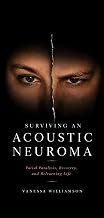 Eventually, those pages became my memoir, Surviving an Acoustic Neuroma: Facial Paralysis, Recovery, and Relearning Life.
Putting my experience into words meant revisiting moments I might otherwise have wanted to forget. But it also allowed me to see something that was harder to recognize while I was living through it: just how far I had come.
The woman in those hospital photographs had no idea what was ahead of her.
She didn’t know when she would walk again.
She didn’t know when she would eat again.
She didn’t know when she would finally sleep in her own bed.
I know those answers now.
There are still things I don’t know.
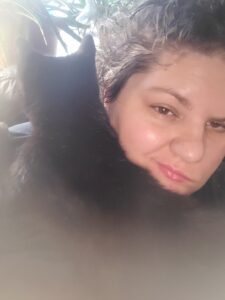 My recovery continues. I still live with facial paralysis, single-sided deafness, balance difficulties, and other effects of what happened. There are things I can do today that I could not do a year ago, and there are things I am still working toward.
Before all of this, I measured my life by bigger milestones: my career, my independence, and my plans for the future.
Now I notice the smaller ones too.
A few more steps. A little more movement. A little more independence. Something that used to feel impossible becoming just a little easier.
When I look at those hospital photographs now, I still feel sadness for the woman in that bed.
But more than anything, I wish I could talk to her.
I would tell her that she is going to make it home.
She is going to eat again. She is going to walk again. She is going to learn how to adapt to things she cannot change. She is going to discover that progress does not always look the way she once imagined it would.
And one day, she is going to take everything that happened to her and put it into words, hoping that someone else facing an acoustic neuroma, facial paralysis, hearing loss, or a long recovery might read them and feel a little less alone.
I think she would have needed to hear that.
I know I would have.