
Rare Community Profiles

Rare Community Profiles is a new Patient Worthy article series of long-form interviews featuring various stakeholders in the rare disease community, such as patients, their families, advocates, scientists, and more.
Empathy through Art: A Mission to Raise Hypoparathyroidism Awareness
In the rare disease world, awareness is crucial. Without awareness, we cannot educate people about rare conditions, advance research, or develop the necessary treatments to help people live fuller and healthier lives. The latter is an especially important point in disease states like hypoparathyroidism where significant unmet needs exist. As explained by pharmaceutical company Amolyt Pharma (“Amolyt”):
Standard-of-care treatments often do not keep calcium levels in the blood stable for a long period of time [and] do not decrease urinary calcium, putting patients at risk of kidney disease. There is a 5-fold increase in the risk of long-term kidney complications and 26% of patients with hypoparathyroidism have already developed chronic kidney disease. Hypoparathyroidism causes abnormally low levels of bone turnover resulting in areas of bone thickening…likely to reduce elasticity and resistance to mechanical stress. Calcium supplementation and active vitamin D do not address this abnormality in bone metabolism leaving patients vulnerable to the risk of fractures over time.
That is why Amolyt is working to both develop novel therapies and increase public understanding of what this condition is. Amolyt recently announced the initiation of the Phase 3 Calypso trial, the largest to date for the treatment of hypoparathyroidism, in the second half of 2023. The trial seeks to build on the success of Amolyt’s Phase 2 trial by assessing calcium blood and urine levels, two important measures in disease and symptom control.
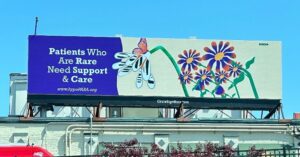
The company also recently partnered with JoAnne Bousquet, who has this condition, and artist Kevvaugh English to increase awareness. In late May 2023, the company unveiled art at Boston’s French Library that was inspired by the experiences and emotions of people living with hypoparathyroidism. This artwork was also displayed on a digital billboard along I-90 in Boston from May 28 – June 3, 2023.
JoAnne and Kevvaugh recently discussed how they got involved in the project—and what raising awareness means to them.
What is Hypoparathyroidism?
Your endocrine system, which includes your parathyroid glands, produces various hormones that regulate processes from cell regulation to blood pressure. In the case of your parathyroid glands, these produce parathyroid hormone (PTH) which balances calcium and phosphorus in the body. Hypoparathyroidism is an uncommon condition characterized by low PTH levels. This causes higher blood phosphorus levels and lower blood and bone calcium levels. Neck surgery, a family history of hypoparathyroidism, autoimmune diseases, cancer treatments around the face and neck, and low blood magnesium levels can all cause the parathyroid glands to secrete too little PTH.
Treatments include Natpara (PTH replacement), high calcium and low phosphorus diets, and vitamin supplementation. Though these can bring levels to normal ranges, these treatments may also come with other health issues.
Symptoms and complications of hypoparathyroidism may, but do not always, include:
- Fatigue and general weakness
- Painful menstruation
- Tetany (uncontrolled twitching and muscle spasms around the mouth, throat, arms, and hands)
- Severe muscle pain and cramping
- Dry, coarse skin and patchy hair loss
- Brittle nails
- Impaired kidney function
- Impaired cardiac function
- Headaches
- Hoarseness
- Teeth malformations
- Tingling and/or burning in the toes, lips, and fingertips (paresthesias)
- Depression and/or anxiety
- Short stature
- Cataracts
JoAnne’s Story
In July 2011, JoAnne Bousquet underwent surgery to have her thyroid removed. She had been diagnosed with thyroid cancer and, though nervous, was ready to get back to her normally active life: running her home-based website design business, working part-time at the local university, hanging out with family and friends.
JoAnne had hoped that, following surgery, she could go home and recover. But the procedure hadn’t gone as smoothly as doctors had anticipated. They had removed two parathyroid glands and damaged one. As a result, JoAnne was extremely ill after and had to spend the night in the hospital.
Once she eventually returned home, her struggles continued. Her muscles were weak; they cramped and tingled when she walked. Concerned that this could signify an issue with her calcium levels, JoAnne asked her endocrinologist at the time. She shares:
“Every time I questioned him about my symptoms, he swore that they were not calcium related. I ended up seeing a cardiologist for heart issues, a neurologist, a rheumatologist who thought I had fibromyalgia. It wasn’t until I obtained copies of my records for a homeopathic doctor that I learned that my calcium and PTH were low.”
Finding Dr. Mannstadt
2015: the year that JoAnne finally received a concrete diagnosis. She had hypoparathyroidism.
Online, she fervently scoured for information. She discovered a hypoparathyroidism-based Facebook group and learned about Dr. Michael Mannstadt, MD, Chief of the Endocrine Unit at Massachusetts General Hospital, Associate Professor in Medicine at Harvard Medical School, and physician-scientist leader of the Mannstadt Laboratory.
This was the doctor who could help her. JoAnne just knew it; she could feel the connection already. She traveled to Boston to see Dr. Mannstadt. Since that first visit, Dr. Mannstadt has played an essential role in helping JoAnne to manage her hypoparathyroidism. She explains:
“I’m on a calcium pump through Mass General and insurance has been great for my hypoparathyroidism needs. I’m on an Omnipod that provides osteoporosis medication, which eliminates the need for calcium supplementation.”
JoAnne also visits the lab regularly, at least once per week, to check her calcium levels. She notes that some people with hypoparathyroidism who are newly diagnosed may not understand the importance of this, sharing:
“If you have hypoparathyroidism, you need standing lab orders. You cannot wait a day for doctors to send a lab slip and you cannot wait six months to check your calcium. I have a lab order slip from Mass General to go twice a week and labs to check other things whenever I need. One day, I hope we can come up with a way to check our calcium from home. But for now, I cannot understate the importance of making sure you’re being frequently monitored.”
Despite this, JoAnne has still struggled with daily or weekly symptoms, as well as fluctuating PTH and calcium levels:
“This has not been an easy road with my thyroid. Dr. Mannstadt and I have disagreed over the years on whether all my symptoms are related to hypoparathyroidism. I’ve come to realize that there are most likely some other health issues going on. But I am not going to stop fighting for answers.”
Lack of Medical Empathy
Of course, this process has been extremely difficult and, at many times, isolating. Throughout her journey, JoAnne has faced medical gaslighting from her physicians, as well as a lack of empathy and understanding from others. She shares:
“I had my surgery done at the so-called best hospital in my state and they have no surgical records of what happened. Over the years, I’ve switched primary care doctors three times due to medical gaslighting. I even recently went for a pain management appointment and my doctor suggested that my symptoms weren’t real but a result of psychological pain.”
Many people with hypoparathyroidism have bladder issues. When JoAnne visited the urologist to discuss, she was told that the answer was simple: she needed to meditate.
During another visit, a doctor mentioned that he had treated tons of people with hypoparathyroidism—and Joanne’s symptoms weren’t a big deal.
On a more personal level, she shares, gaslighting can also come from friends or family, especially in the case of “invisible illnesses:”
“People think I look okay and healthy so they question how I could be sick. It’s been over ten years and I finally feel like I don’t need to prove myself to anybody anymore. I definitely have days where I think about what people have said and it hurts. But I’ve come to accept that this is the way it is.
I want the medical community and people around us to understand, see, and hear what people with hypoparathyroidism deal with. One of the biggest ways they can support us is to have compassion and learn about the conditions that affect us so profoundly. My plans for the future are on hold, but I have hope left. I stayed positive when I was diagnosed with cancer. I kept fighting when I was sick after my surgery. But the longer it’s been, the more I see my hope fall. If people could educate themselves and have some empathy, it would make our lives a little easier.”
Raising Awareness through Art
When JoAnne learned about the opportunity to work with Amolyt, an artist, and other people with hypoparathyroidism to raise awareness, she jumped at the chance. So did Kevvaughn English, an artist who originally hails from Waltham, MAand graduated from Lesley College School of Art & Design in May. An avid bike rider, cook, and abstract designer, Kevvaughn saw an opportunity to make a change. His application and design portfolio were accepted by Amolyt and he began working more closely with JoAnne, Amy, and Chari (two other women in this initiative) to establish a connection and understand their stories.
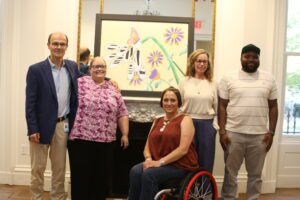
Regarding his art piece, Kevvaughn explains:
“We brainstormed ideas to keep it visually beautiful but also wanted to mention their symptoms. So I created a bed of flowers with one that is wilted at the forefront. I was inspired by my wilted tomato plant at home. No matter what I could do, I couldn’t get it healthier. I learned that—just like humans with hypoparathyroidism—tomatoes require calcium. That connected this idea of nature with the human side. Finally, I wanted to focus on the care and empathy aspect. The idea of empathy is so important when trying to really understand what the patients dealing with hypopara have gone through.”
Alongside the art is a slogan, created collaboratively with the group: People who are rare need support and care.
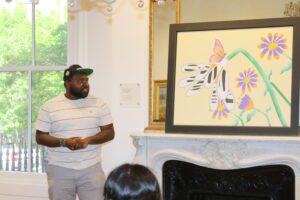
Seeing this up on the billboard was incredible, says Kevvaughn, who felt flooded with excitement and pride.
The Push for Better Understanding
Ultimately, this opportunity presented the amazing chance to increase hypoparathyroidism awareness and understanding on a greater scale. But JoAnne hopes that this impacts more than just the greater public; she hopes that this also encourages people living with this condition to speak up, share their stories, and advocate for themselves. She leaves everyone with some final advice, saying:
“It’s important to take care of yourself. Advocate if you aren’t getting the help you need. Reach out to other people who understand the difficulties of hypopara.. Be grateful for the good days that we get. Practice mindfulness. And most of all, stay hopeful. Tomorrow might be a much better day.”