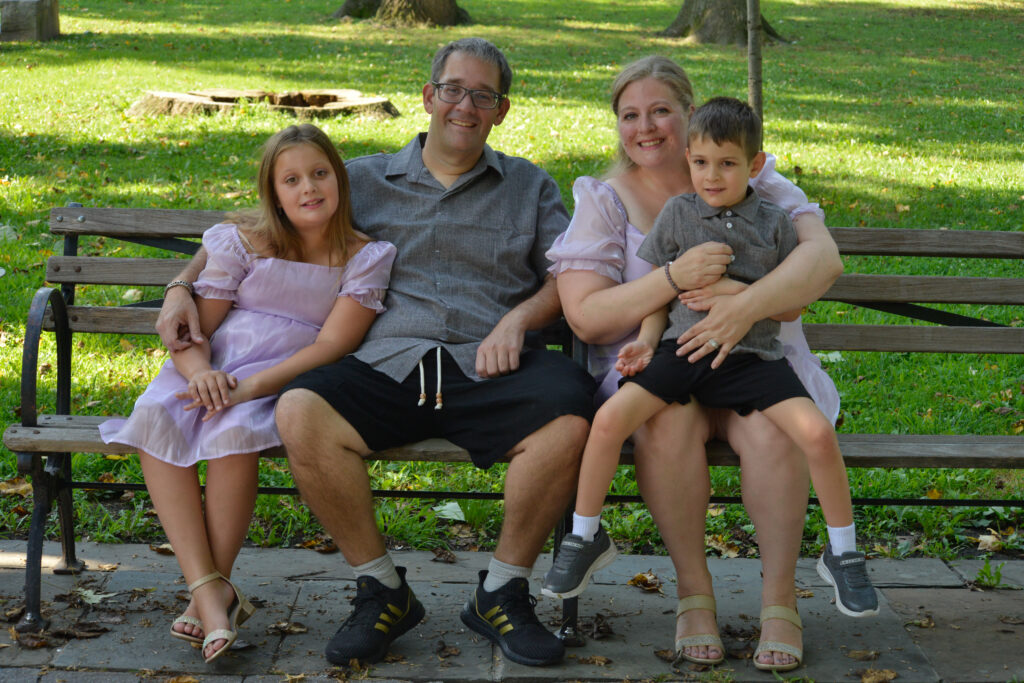
Danielle’s baby boy had a long and terrifying seizure on the 4th of July six years ago. The family was at her mother’s home. Both Danielle and her mother are nurses. They rushed the infant to the hospital. He was treated immediately with rescue medication for seizures through IV. While the seizure stopped after approximately 30 minutes, Danielle’s gut and experience told her that this was not a febrile seizure or an otherwise benign event. His second seizure did not stop with rescue medication as they had hoped. It was not until the following Fall, however, and after several more seizures, that genetic testing revealed that their baby had Dravet Syndrome – a rare, severe and devastating form of epilepsy caused by a genetic mutation, most commonly in the SCN1A gene. Dravet is classified as developmental epileptic encephalopathy (DEE). This means that this is not only a seizure disorder but that the seizures are more drug resistant and that developmental delays, both cognitive and physical, are a part of this complex condition.
An epilepsy gene panel can be done for children or adults with unexplained seizures. In children it can often be done at no cost to families willing to share unidentified data through many sponsored testing programs. A genetic counselor can assist you. https://findageneticcounselor.nsgc.org/]-fd
Johnny cannot speak, he cannot feed himself, he cannot take care of his own toileting. At night both his oxygen and heart rate are monitored electronically because of the risk of sudden death by epilepsy called SUDEP (Sudden Unexpected Death in Epilepsy). He has a vagus nerve stimulator implanted to help stop the seizures and has seizure rescue medication available both at home and at school. Lack of sleep has been a trigger for his seizures and so if he has not slept well, his parents will let him go to school later. Despite his challenges, Johnny remains a loving and easy- going little boy.
Johnny goes to public school but also receives some therapies at home. He plays with his older sister, he is beloved by all of his grandparents who live near-by and see him frequently, providing much needed support to his Mom and Dad. Danielle says her Mother-in-law “has been my right hand with Johnny. She recently had surgery and is in rehab, and I really miss her.” Her Father-in -law also provides text communication with the school while Danielle is at work and frequently picks him up. They all know his cues and anticipate his needs.
Johnny enjoys vacations with his family, often to the shore and to Disney World. His parents have been blessed to have two phone buddies with children with Dravet Syndrome, and they have been active in the Dravet Facebook support group. Danielle advises others with this diagnosis to find another family to be mutual support. She says that as a nurse she “had empathy, I cared, but until I had a child with Dravet, I truly did not understand.” She is excited to be going to Hershey, PA this fall to one of the five Day of Dravet events the Dravet Foundation puts on across the country on alternate years with this large national conference. She will meet some families in person for the very first time.
Danielle has been on top of the latest research, and has been glad for the assistance of the Dravet Foundation Dravetfoudation.org
There are 6 clinical trials in the works for Dravet that are testing therapeutics. There are also various other types of studies of biomarkers, genetics and behavior in Dravet. Danielle and her family know that a clinic site for the Stoke Therapeutics Emperor study has been chosen near her. They are now hoping that their son will be selected for the trial. This is a phase 3 clinical trial evaluating Zorevunersen (STK-001) as the first potential disease-modifying medicine for Dravet.

Danielle ‘s advice to other Moms is:
- Trust your instincts, you spend the most time with your child.
- Don’t hesitate to get a second opinion.
- You need to have a team to care for your child.
- Plan and have back up plans A, B, C, D.