I thought I wanted a second baby. My son was an adult, and despite having an adorable Frenchie, I was ready to take steps to get to the baby smell. Like many women, I had fibroids. After a few years of painful cycles and finally working up the nerve to get rid of them, I had a myomectomy. In the weeks following, I began seeing blood in the toilet and returned to my gyno. After checking me out, he confirmed there wasn’t anything wrong with my uterus, but he suggested a colonoscopy. Why would I think at 44 I’d need a colonoscopy?
A cancer diagnosis on May 20, 2023 changed everything. In the days that would follow, I learned I had stage 3 colorectal cancer. My diagnosis came within months of the adjusted screening age. At 45, I was more focused on perimenopause, not a colonoscopy. As fate would have it, not only would I have a colonoscopy, I’d be facing 12 rounds of chemo, major bowel surgery, countless doctor’s appointments, and a whole lot of twists, turns, and now, survivorship.
Like many cancer patients, I had no idea what to expect from the treatment journey. My reference for chemotherapy was from television and movies. Who knew genetic testing was a thing? Like most people who get a cancer diagnosis, I decided to pick the best-case scenario and settled on stage one, maybe two, as my fate. Well, reality set in when I was asked to bring my sisters and son in his early twenties to have genetic testing done. And stage two was a fantasy: I was devastated to learn I was actually stage 3C, dangerously close to stage 4. Beyond what I’d seen in media about cancer, I had no reference for what to expect for my treatment. Until 2020, when Chadwick Boseman died because of the disease, I associated colorectal cancer with old men. Our diagnoses proved otherwise.
Ahead of the disease, I had no idea tumors take 10 to 15 years to grow. If my tumor took 15 years to present, that means I likely had cancer at 30. At 30, I’d given no thought to having a colonoscopy. In my mind, that was at least 15 years into my future. At 30, the year the tumor could have first appeared, I was raising a young son, climbing my way up in my career, and not thinking once about my eventual diagnosis.
Knowing what I’ve learned from my own experience, I take every opportunity possible to share how important having a colonoscopy is. With the recommended screening age being 45, I encourage anyone who’ll listen not to wait until then. Start the conversation about colon health in your 30s, proactively. As I think back to my 30s, conversations connected to my health were about fertility and physical fitness. Going to the gym, following the latest fitness crazes, and making sure I looked healthy was my priority. Now, as a 48-year-old stage 3C colorectal cancer survivor, I know appearing healthy on the outside and thinking my 30s are too soon to consider a colonoscopy isn’t the right approach. At any age, asking questions, getting more information, and taking steps to maintain your health is key. In my 30s, 45 seemed so far off. I thought I had more time before I’d be susceptible to an old man’s disease. I was wrong. Unfortunately, colorectal cancer doesn’t ask any of us our age before it strikes. Maybe our reluctance to talk about or seek out colonoscopies is us not wanting to accept our mortality and how aging is unavoidable. I can remember thinking 45 was old and colorectal cancer was something an old man had to worry about. Now, I know none of that is true. Today, I’m grateful for all 48 years of my life and the colonoscopy that saved me. It’s taking the active steps to stay strong, cancer-free, and having frequent, proactive conversations that can offer options in case there’s something I need to pay attention to. I recommend the same to anyone who will listen.
As easily as we share our favorite restaurants, new series to stream, or podcasts to listen to, we ought to get in the habit of talking about the steps we can take to save our lives. At 48, a great nap is one of my favorite things. It’s a very middle-aged thing to do. A colonoscopy marries two things I love: a restful, quick sleep and staying alive.
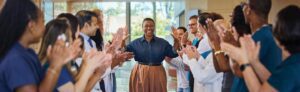
2026 marks so many milestones connected to my illness. This year marks 2 years NED, the third anniversary since ending my first rounds of chemo, and one year since my first Walk for Hope. At the end of 2025’s Walk, I was already preparing for this year’s. Being back on City of Hope’s campus on a day that wasn’t to meet a doctor, take a test, or have a hard conversation was special. I was elated to be amongst other amazing people who were there to celebrate a collective victory for anyone who’s heard “you have cancer.” Participating touched my heart in a way that’s still palpable, flashing me back to being a patient looking out the window from inside an exam room or hospital bed. Down on the ground, people are marching and cheering for patients who are fighting for their lives. I now know both sides. I realized my steps and the funds I raise would touch the life of someone I’ll never meet, and someone had done the same for me when they put on their sneakers and walked. Surrounded by friends and family this year, I’m beyond grateful to be back for Walk for Hope 2026.