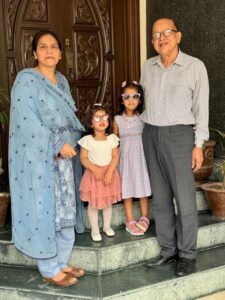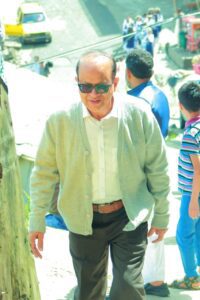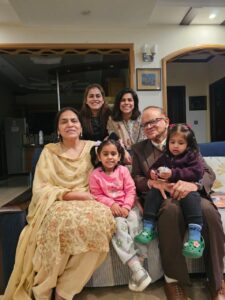
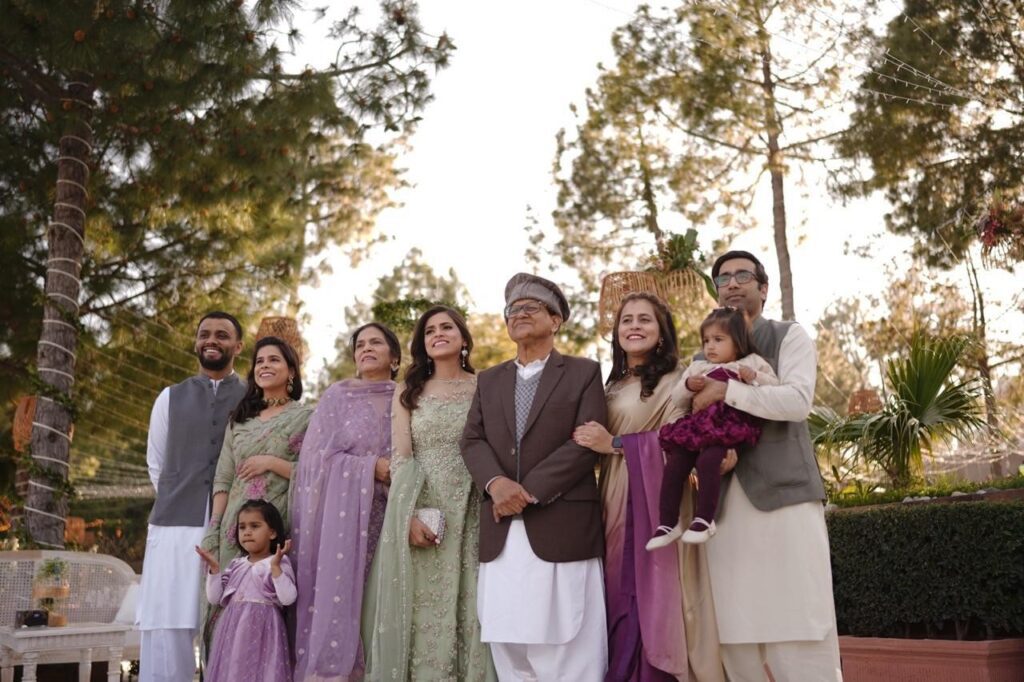
My name is Maha, and I had the privilege of being my father’s — my Baba’s — caregiver.
I’ll be blunt; it was tough. When you live in a developing country like me, with low income, you face many challenges that a lot of people never even consider. Even though I spent 23 months trying to fight for, support, and ultimately lose my father while he had terminal cancer, I wouldn’t change a single thing about those two years. He was loved so much by so many people, and I would do it all again without even thinking about hesitating!
September 21st, 2023 is etched in my memory, because it was my birthday. I was working a normal day as a dentist doing dental work on patients. Then I got a phone call from my little sister who told me that my father had gone for a standard routine eye exam and was told he had developed glaucoma (an increased pressure inside the eye). There was something strange, almost like I was imagining it. He had always been the healthiest person I knew and was a physician also, a consultant paediatrician and neonatologist, who cared for sick children every day. We had no fear when he was originally diagnosed with glaucoma, which did not seem to be a disease that could threaten his life. We were not fearful – not yet.
In November, the pressure in his right eye hadn’t settled down yet. The eye drops weren’t helping either. The doctor recommended having cataract surgery since it might help alleviate the pressure in some cases.
When Baba had his eye operation, he arrived back home after surgery on his own, showing the same level of independence and strength that had characterised him for his whole life. We were told that the procedure went well, but just over four hours after surgery, when we took off the bandage as instructed, we found that Baba was blind in his right eye.
The following days included much confusion about what had happened, as well as much fear and seeking answers to questions we had after multiple consultations and second opinions; however, there was no definitive diagnosis. Then, he began to heal slowly but began to realize that there was still a defect in his vision caused by a problem on the right side of his visual field, and he could not obtain any explanations from the specialists we consulted regarding his eye problems.
Baba was still working full-time as a priest and was noticeably cranky. Gradually, though, he began to show other symptoms of being stressed. The first signs were relatively minor and easy to overlook — he would attempt to write using the wrong letters or confuse his word order. We all thought we were being supportive of him by encouraging him to relax, and that it was normal to feel chaotic at times like this. However, Baba could not conceal how upset he really was about all the things going on around him. He was aware of his situation and had too much intelligence and consciousness to deny what was happening.
On the 27th of January 2024, he advocated for himself. He walked into his clinic, then to the radiology department, and got an MRI done. That’s when we saw it. A lesion in his brain.
5cm x 4cm. Within the parietal lobe. Everything indicated a neoplastic cause. But even so… we kept hope alive. We prayed that it would not be something as evil as a neoplasm. That it would be something easy to treat. Possibly an atypical abscess.
Regardless of the underlying cause, there was only one thing to do: brain surgery — and the sooner, the better! That’s when we met an exceptional surgeon who gave us hope during a very difficult time. Baba had a craniotomy performed on 02 February 2024. We put all of our faith into removing the tumour and sending it away for pathology.
We spent days in the ambiguous space of our fears and our hopes, waiting. February 20th came and that day was the day our entire existence crumbled.
The biopsy revealed what we were afraid of, a glioblastoma– WHO grade-4 tumour. Before we even had a chance to visit the oncologist, we took the necessary steps that everyone takes – research. We needed to understand this beast we were fighting against, and quite frankly what we found was horrible. The words: aggressive, no cure, poor prognosis were being thrown at us and they were real. The only survival statistics are 9 to 12 months, even with treatment, and then it will have recurred.
The glioblastoma is an adult primary brain cancer that can be characterized as the most aggressive form of primary malignant brain cancer. It originates from astrocytes and exhibits rapid, invasive growth, widespread necrotic tissue, and abnormal blood vasculature. What makes glioblastoma an extremely lethal malignancy is not only the rate at which it grows, but also its microscopic invasion of surrounding brain tissues, which makes total resection of the tumor an almost impossible task.
Although it is a rare condition, affecting approximately 3–5 individuals out of every 100,000 annually, the toll it takes on your life is staggering. Even with typical treatments, including surgery, chemotherapy, and radiation, the average length of time you will survive is 12–15 months. It is almost certain you will have a recurrence, typically within 6–9 months. That’s the part that will quietly crush you.
While there have been some advances in treatment over the past many years, for the most part, very little has changed. Most patients are treated according to a standard protocol; this includes surgery followed then by six weeks of combined chemotherapy and radiation, and additional rounds of chemotherapy thereafter. Although this is considered the best possible treatment, it still is not enough. You follow the protocol and continue to have hope, but you also are constantly aware that it is going to get worse. Steroids with the risk of seizures, and various other side effects — it is not just the illness creating your grief; it is all of the side issues surrounding that. I think it was made harder by how isolating it has been for me. A rare disease with limited resources available — no availability for clinical trials — and having conversations with people about your disease always end up going in a circle and then returning back to the same place; this has left me and so many others feeling isolated and alone.
We were our own advocates!
The rest of the world seemed to progress while we remained stagnant. Other families receive many diverse forms of rehabilitation that could assist patients regain functionality; however, we experienced such limited access to rehabilitation. Access to effective physiotherapy, occupational therapy and speech therapy can change the quality of a patient’s life, yet we had nothing available to us. In addition to all the other struggles and challenges we experienced, my mother and sisters gave their father full-time care. Our family reached out to fellow patients and caregivers all over the world to learn from their experiences about how to provide proper care. Our father fought valiantly for 23 months against cancer.
It is easy to feel lost when you receive a diagnosis of GBM as it can feel as though the world (as you know it) has just shifted under foot. As you begin your journey, concentrate on taking it one step at a time—don’t push yourself to try and understand everything all at once. Be sure to find a quality (multidisciplinary) team that you trust and feel comfortable with to provide your healthcare. Although it might appear silly, please don’t hesitate to ask questions, regardless of how small those questions may be, when meeting with this team. If possible, bring someone with you (family or friend) to help with the processing of the information you receive during these appointments and to avoid feeling as though you are all alone in this journey. It is common to begin researching information about your GBM diagnosis. However, please remember to rely on credible sources and do not allow the statistics to consume you; they are not the same as your experience.
Spend your time and energy on that which you can manage yourself; for example, to be comfortable, to build a support network, and to have moments of comfort and fulfilment on a daily basis.
Accept help when it is offered and be kind to yourself emotionally and physically. On some days the load will be heavier than on other days, and that’s fine! The most important thing you can do is to stay hopeful; whether it is for time, for your quality of life, for having connections with other people, or for having lived through some beautiful moments that still have warmth or meaning attached to them. Even during our most challenging times, those moments will always have a very special place within us.