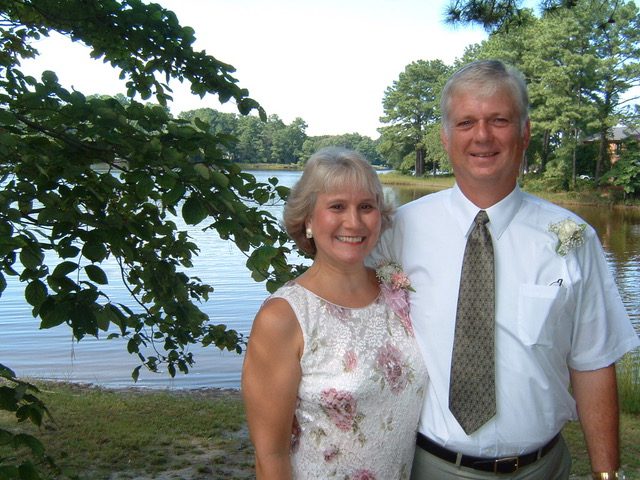
Editor’s Note: This is part 1 of a 3-part caregiver story, submitted to us by Joan Foster, who was a caregiver for her husband Charles’ Chronic Kidney Disease (CKD).
Hold on! Hold on! There is nothing funny about dialysis! Keeping it all serious, NO, there is nothing at all humorous about the life-saving process of dialysis. But, without seeming irreverent and lacking compassion and sensibility, my husband and I would like to share our comedic experiences during Charles’s manual peritoneal dialysis done at home with the supervision and help of his care partner. Yes, the care partner would definitely be me, his wife and best friend and advocate. After a few weeks of training at the Kidney Clinic with our great RN instructor, we were ready “to take it on the road,” so to speak. Our instructor transported everything we needed to get started at home . . . all of the supplies for manual pd . . . boxes of dialysate, a heating pad to warm the dialysate, an IV pole and organizer to place on the pole for the “drain” portion and then the “flush” part and then the “fill” segment. To keep everything clean and as sterile as possible, we had lap pads and hand sanitizer and syringes and bottles of Heparin and square tissues and a bottled bleach solution for disinfecting the small rubber top on the Heparin bottle and the injection tube on the dialysate bag where the Heparin is injected. Basically our RN instructor would only allow me to carry the lightest items, while she hauled the heavy boxes of dialysate into her car when leaving the center and then again unloading her car at our home. We thought for sure that woman was going to have bigger biceps just from getting us all set up for home dialysis!
I have deliberately omitted all the details of the training at the Kidney Clinic and the first announcement at the Nephrologist’s office that Charles would need to start dialysis ASAP. This booklet is entitled “Some Dialysis Humor” and, trust me, there was no humor to be found in either of those experiences. Before delving into the humorous aspects, it would be unfair not to mention that all of this dialysis stuff came about very quickly and with no time to spare, to borrow an over-used cliché. To provide a little or a lot of background, Charles’s kidney function tests had been showing troubling values/numbers for several years, but in the previous 16 months, his CKD, Chronic Kidney Disease, progressed so quickly, it was almost unheard of in case studies. We kept regular appointments with his nephrologist every couple of months, so he was followed very closely, but things still moved very quickly with his declining kidney function. On Christmas night 2020, as we were visiting at our son’s and his family’s home in Georgia, Charles began feeling ill and having difficulty breathing. 911 was contacted and Charles was stabilized on the ambulance before transport to the hospital. For conciseness and clarity, here are the reports of that event and the following crises: 1. 12/2020 – Heart Attack with Heart Failure; 2. 02/2021 – Mini Stroke w/ hospitalization; 3. 03/2021 – Atrial Fib Heart Attack; 4. 03/ 2021 – ((5 days later while still hospitalized with Afib infarction) – Stroke with brain bleed which thankfully resolved. All of these serious medical issues within a 2 ½ months-time-frame. We had lots of questions but were informed that Charles’ heart and his kidneys were doing battle with one another! To top it all off, his kidney functions were worsening with every crisis. What to do? Well, first Charles’ heart must be preserved as much as possible, so address that first. April 2021, ICD Implantation, also known as pacemaker/defibrillator put in his chest, ICD meaning Internal Cardioverter Device. Next, surgical procedure to “install” the port in his arm for hemodialysis (HD) to begin as quickly as possible, giving the fistula time to heal enough. Not going to happen! Charles had another high blood pressure issue for which he had to be hospitalized and time was running out. That’s how our peritoneal dialysis done at home began. Within days, another surgical procedure in his abdomen, the peritoneum, to place a catheter tubing with several inches displayed outside his body at the exit site. Sufficient time for healing from that procedure, then the training began.
So, back to the first day at home with our RN instructor standing by to oversee that everything I had learned in training was being done correctly. Charles had paid close attention to every step during the training and he watched every step for our “first run.” Charles’ nephrologist was adamant that he not try to do the manual peritoneal dialysis himself, as his short-term memory had been affected by the strokes.
With all of this background, hopefully I have set the stage for the experiences I describe below with dialysis. So, as you can imagine, we took dialysis very seriously given all of Charles’ health problems, as stated earlier, however, as time passed by and more skill at doing manual dialysis occurred, we both discovered that from time to time, we found humor, small as it was at times, in the whole process and what we were learning or imagining about it all. No doubt, you have heard that old saying that “Humor is the best medicine!” Or that trying to find the funny side of everything can really help to get through the struggles of life. Well, this booklet has been written for that very purpose . . . to illustrate how we incorporated humor into our own dialysis experiences and, hopefully, to help all of you readers to consider a little comedy yourselves, in your personal and family experiences with dialysis. One footnote right here is: Not one word of what we share comes from a textbook or any training handouts about dialysis. Not one word of all that we include in this booklet is something we heard someone else state or laugh about. If there is another booklet out there somewhere on this topic, I have never seen it nor read it nor had anyone quote anything from it!
Ok, now I am really back to the first day at home, I promise! Our RN instructor kept smiling at me as I carefully and slowly placed the warmed bag of dialysate which she had brought from the clinic with her so that Charle’s first at-home fill would be warm, so as not to possibly cause any cramping. I drew up the Heparin in the syringe, after sterilizing the top of the Heparin bottle, then held the syringe up to the light to make sure it was the correct amount. Next, I sterilized the injection tube on the dialysate bag, waited for 2 minutes, then injected the Heparin into the dialysate. “Oh my goodness!” I stared at our RN nurse who was beaming at me now, “I had all those meltdowns and tear-filled-anxiety-produced-profusely-sweating attacks at the clinic during training for nothing!” I hung my head sheepishly. She patted my shoulder and replied, “And you kept insisting that you were not a nurse, had never had any desire to be a nurse and that only a nurse should do all of this dialysis stuff!” I grinned and Charles grinned at me. “Now here you are CRUSHING IT!” she said. With that word of encouragement before she departed our home, I suppose I should admit that I was right proud of myself. Until 4 hours later, when it came time to do the next manual exchange, the one that would fill Charles with the dwell that would stay in all night, for about 9 hours! All went well on that once-dreaded first day on our own and a few hours of restful sleep was gained by both of us.
About the Author:“Counting our ‘courting’ year and marriage, we were together for close to 23 years. He began his decline Christmas night, December 25, 2020 when he had his first heart attack, while we were visiting my oldest son and his wife and family in Georgia. I became his full-time caregiver and care partner that evening and remained in that place until his death on June 23, 2025.” – Joan