Editor’s Note: This story was originally written and submitted to us by Anthony Clark.
“Okay, Michael, hold the ball up to your ear, then throw it! Just like this: ear, throw!” Nothing.
“Michael, we’re not leaving until you catch and throw the football.”
It was the summer of 2020, a few months into the COVID lockdown, and my ten-year-old younger brother and I were locked into a two-hour standoff in our backyard. I’d thrown the football to him hundreds of times. Hundreds of times, it had bounced uselessly off his chest and fallen to the grass. Michael knew how to catch. He was choosing not to.
A sly smile crept across his face. Challenge accepted, it seemed to say.
I should note: Michael doesn’t bluff. I knew this from a decade of lived experience. I issued my ultimatum anyway, because I was twelve and had not yet learned that some battles cannot be won.
Let me back up. Michael has an extremely rare neurodevelopmental disorder: X-Linked intellectual Disability #98, or XLID-98 for short, and is one of roughly 200 known cases worldwide. He’s also one of the happiest kids I know—just certainly not a typical one.
His working vocabulary hovers around one thousand words (we’ve counted) and is dominated by his two primary passions: food and people. He also struggles with hypotonia, GERD, ADHD, and significant impulse control issues, among other challenges. My family spent six painstaking years in search of a diagnosis before genetic testing finally revealed a pathogenic mutation in the KIAA2022 gene, indicative of XLID-98, when Michael was six.¹

Michael’s genetic report, October 2015
Clinical literature on XLID-982 suggests that 58 percent of affected males are nonverbal.² Michael, however, defies these statistics, absorbing complex language like a sponge and reciting it when least expected. Eighty-three percent of patients suffer from seizures, which he hadn’t experienced (and still hasn’t to this day, knock on wood). While sixteen percent have poor coordination or ataxia, Michael’s coordination is excellent. His judgment about when to deploy that coordination is another matter entirely: he’s so remarkably strong and quick that he’ll have leaped out of his kitchen chair, turned on the garbage disposal, unspooled an entire roll of paper towels, and be gleefully holding the glasses he snatched off your face before you’ve finished saying “Michael, no.”
He may have a “profound intellectual disability” by clinical standards, but within the XLID-98 community, he’s defying expectations. We like to think his natural intelligence is somehow compensating for the ways his condition affects brain development.³ That, or the extensive occupational therapy we subjected him to from age two. We prefer the former, giving the credit to Michael rather than our exorbitant insurance premiums.
Before COVID, Michael began attending our public elementary school, which afforded my dad, his primary caretaker, a few brief moments of solace. His schedule shifted from 24/7 caretaking to something resembling an on-call physician—staying tethered within a few miles of the school and anticipating the inevitable call that Michael had pulled Suzie’s hair again, or discovered that the fire alarm was, in fact, pullable.
Michael has always had an affinity for glossy objects. But now, amidst the pandemic shutdown, my dad was once again relegated to primary caretaker status. His support system had shrunk to three people: my mom, me, and Michael’s caretaker Robin. We affectionately call her Saint Robin, for her incredible commitment and her miraculous ability to defuse a Michael Meltdown when the rest of us have already accepted defeat.
But back to the backyard standoff. On that particular afternoon, I magnanimously decided to be the Gracious Big Brother and forgo riding Razor scooters with my fellow neighborhood twelve-year-olds to instead play a wholesome game of catch with Michael.
Now, Michael has remarkable hand-eye coordination and a veritable cannon for a throwing arm, even by Typical Kid standards. I knew from firsthand experience he was entirely capable of catching and throwing a wide variety of objects. But that afternoon, every pass I sent his way was met with a stoic refusal to use his hands, letting the ball thud against his chest instead. When prompted to throw it back, he would offer a pathetic underhand toss that barely cleared his own feet.
The ungrateful little turd! Here I was gracing Michael with my limited adolescent free time, and he had the audacity to toy with me like this? Enough. I had staked my Older Brother Authority on this hill, and I would die on it if necessary.
***
Two hours later, we hadn’t moved. The sun was sinking lower. My pride was growing more entrenched. Somewhere, my neighborhood friends were doing tailwhips on their Razor scooters, and I was losing a war of attrition to a ten-year-old who appeared to be having the time of his life.
“Michael, you KNOW how to do this!” I exclaimed, my frustration peaking. “Hold the ball to your ear, then throw it. Ear, throw.” I demonstrated the motion for the nth time, and the football bounced off his chest for the nth time.
Then: chaos. Michael clutched his chest as though mortally wounded, crumpled onto the grass with the dramatic commitment of a Shakespearean lead, and unleashed his blood-curdling Anthony Hurt Me Shriek. Realizing I had roughly thirty seconds to vanish before my parents discovered Prince Michael supine in the yard and the smoking gun (football) in my hands, I bolted for the backyard gate.
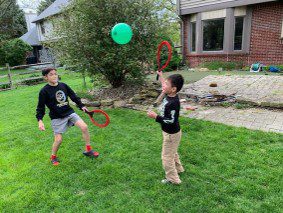
Michael and I, c. 2020, at the site of our fateful backyard standoff.
My dad beat me there. I stopped dead in my tracks, frozen like a deer in headlights, racking my brain for a plausible alibi. Michael, having worked himself into a frenzy from the Hollywood-caliber performance he’d staged, was now screaming bloody murder at the top of his lungs, pausing only to draw in gasping breaths before resuming his eardrum-bursting shriek. Much to my relief, my dad (ever the pragmatist) bypassed the stern lecture, instead scooping up Michael’s writhing 80-pound frame and hauling him toward the car parked in our driveway. He was employing the only proven sedative for a Michael Meltdown: an hours-long drive down Ohio country roads until the rolling hills lulled Michael to sleep. Overcome by a pang of guilt, I scrambled into the backseat, unwilling to let my dad jump on the Michael Grenade alone. Together, we secured Michael into his custom restraining harness in the backseat with the frantic precision of a NASCAR pit crew. My dad climbed wearily into the driver’s seat, gunned the engine, and we were off.
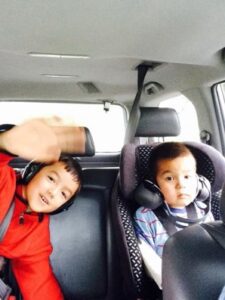
Mid-drive through Ohio cornfields. The noise-cancelling headphones, as one might imagine, were non-negotiable.
Michael’s cries gradually abated as we wound along a country road through the near-endless sea of swaying cornfields. He had now taken a keen interest in his blue Nike sneakers instead. With cat-like dexterity, he slithered out from under the straps of his harness and began tugging at his shoelaces. Though unable to tie his own shoes, he was more than capable of untying them. Knowing better than to wrestle him back into his harness and risk inciting another nuclear meltdown, I simply observed with amusement and curiosity.
He slipped off a shoe, cocked it to his ear—ear—, then locked eyes with me as if to say Watch this. By the time I recalled the second half of the lesson, it was too late.
“Ear… THROW!” Michael bellowed with immense pride as he hurled his shoe at the back of my dad’s head with the force and technique of an MLB pitcher. The shoe struck my dad squarely in the ear, startling him and sending our car swerving toward the shoulder.
“Gosh dangit, Michael!” my dad exclaimed as he narrowly regained control of the wheel and lurched the car to a halt. Michael hadn’t heard an expletive quite like that before, but he seemed to infer the meaning. We drove home in heavy silence.
***
Later that night, the three of us had grudgingly made amends. We sat on either side of Michael in his bed, reading a bedtime story under the warm embrace of his velvety covers. Michael was in a snuggly mood now, his head nestling in the crook of my dad’s shoulder, then shifting over to mine as we turned each page. My dad always said that one of these intimate moments was worth a thousand Michael Meltdowns, and looking back, I wholeheartedly agree.
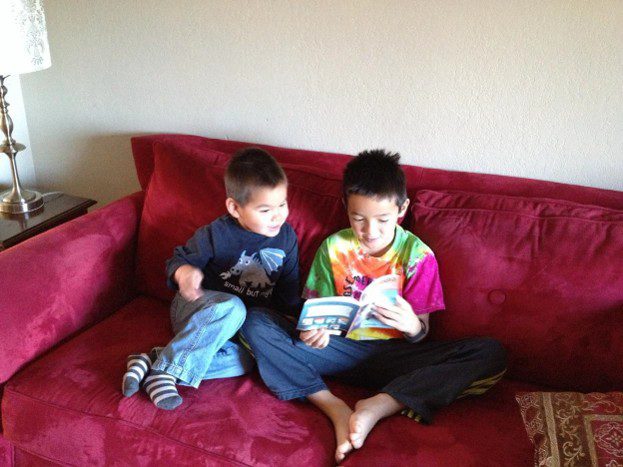
That night, we were reading a regular staple of ours: The Raven by Edgar Allan Poe.⁴ It’s not the most conventional bedtime story, but then again, we aren’t the most conventional family. Our reading routine is a collaborative effort: my dad or I will read a sentence, then Michael will provide the last few words from memory. Michael can’t read, but his sponge-like memory doesn’t require literacy. It just needs to hear something once to then recite it at will. He has quite the diverse repertoire of works memorized—from Green Eggs and Ham by Dr. Seuss to The Tragedy of Julius Caesar and Hamlet by Shakespeare.
Michael, the most avid reader who can’t technically read.
Michael’s eyes sparkled as my dad reached his favorite stanza, pausing at each line for Michael to fill in the ending.
“Wretch, I cried, thy God hath…”
“Lent thee!” Michael crowed with theatrical glee.
“…by these angels he hath…”
“Sent thee!”
“Respite—respite and nepenthe from thy memories of…”
“Lenore!”
“Quaff, oh quaff this kind nepenthe and forget this lost…”
“LENORE!”
Each response had grown louder than the last, and by the final Lenore, Michael’s eyes had gone slightly manic. Poe has that effect on readers. The sparkle in Michael’s eyes hardened into a defiant expression I knew all too well: his impulsive self, rearing its head, demanding he grab the nearest object within reach. With lightning-quick speed, Michael lunged for the open page before my dad could intervene, tearing a clean gap between Poe’s sunken eyes. In his defense, it was a glossy illustration. The page was already patched with layers of tape from previous incidents. Poe had seen things. Poe understood.
My dad pulled the book away with a defeated sigh, too exhausted from the day’s events to muster a formal reprimand.
Generously, Michael provided one himself.
“Gosh dangit, Michael!” he declared with evident satisfaction. His working vocabulary had officially reached one thousand and two words.
My dad’s eyes widened in parental horror—his Oh My God What Have I Done look—but I couldn’t help breaking into a fit of rambunctious laughter. Finally chuckling himself, my dad grabbed a fresh roll of tape, stitched Poe’s hollowed eyes back together, and continued to read:
“Quoth the Raven…”
“NEVERMORE!”