For a long time, I knew something was wrong.
And then, when whatever had been building inside my body finally came to the surface, it didn’t arrive quietly.
It detonated.
There was no gentle progression from something isn’t right to something is very, very wrong. Once it started, it was brutal and overwhelming. My life didn’t gradually rearrange itself around illness. It was ripped apart by it.
By the time I was finally diagnosed, I was in the hospital and an absolute wreck.
My first reaction wasn’t to cry. It wasn’t denial. I didn’t ask Why me? or What happens now?
I turned to my family in the room and calmly said:
“I told you.”
Literally.
That was my response to being diagnosed.
I told you.
I’ve thought about that moment a lot over the years, and what strikes me now isn’t that I was right. It’s how badly I had wanted to be wrong.
I wanted everyone who had doubted what was happening to me to be right instead.
I wanted to be well.
That sounds ridiculously obvious. Of course a sick person wants to be well. But I think it gets lost when we talk about what disbelief actually does to somebody.
When you’re sick, especially when your body is changing in ways you don’t understand and can’t control, there is a grief that is almost impossible to explain to somebody who hasn’t experienced it. It isn’t necessarily grief for something cleanly lost. Sometimes you’re grieving things that are still technically yours: your independence, your plans, your confidence in your own body, an ability you had yesterday and might have again tomorrow.
Sometimes what you lose first is certainty.
You don’t know whether this is temporary. You don’t know whether tomorrow will be better. You don’t know whether this is the beginning of something or just a terrible day.
So when somebody tells you that perhaps it isn’t as bad as you think, their doubt can offer something you desperately want.
An escape hatch.
Maybe they’re right.
If they’re right, maybe you’re okay. Maybe this isn’t your life now. Maybe whatever you’re terrified is happening to your body isn’t actually happening.
That is how someone else’s doubt can become your own.
You start trying their explanations on.
Maybe I’m just tired. Maybe I’m stressed. Maybe I’m paying too much attention to my body.
Maybe I just need to push through.
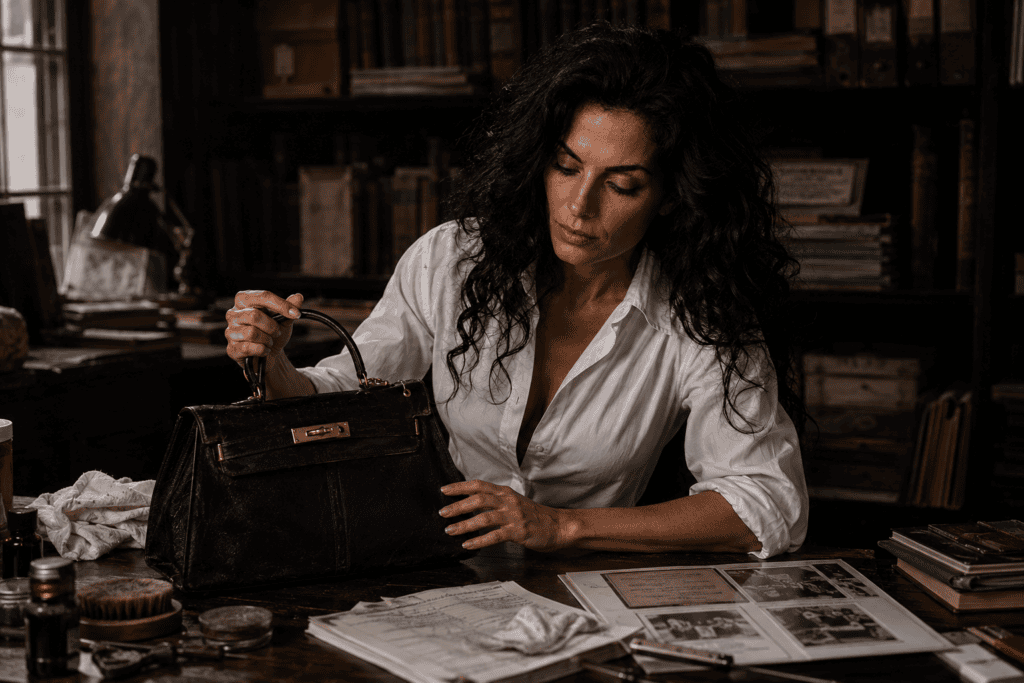
I actually have an old brass PUSH sign in my workspace. It’s vintage, of course. I bought it because I liked it, and there is something almost ridiculous about the fact that it ended up in my room.
PUSH.
As if I needed the reminder.
I’ve spent years pushing through things. Symptoms. Pain. Uncertainty. The fear that stopping meant giving in. And probably worse, the fear that maybe everyone else was right and I really could do it if I just tried harder.
When you desperately want to be well, push through is seductive because it leaves open the possibility that you still have some control over what is happening.
Maybe this isn’t really happening to me. Maybe I can still be who I was. Maybe they’re right.
And sometimes I desperately wanted them to be right.
That’s the part I think people miss when they doubt someone who is sick. You may be telling us exactly what we desperately want to hear.
I don’t want to cancel the plan. I don’t want to need help. I don’t want an accommodation to be necessary. I don’t want something I used to do without thinking to become something I have to calculate.
I want to push through.
Sometimes I can.
Sometimes I can’t.
And sometimes I can, but I pay for it later.
The problem was never pushing. There are times when pushing myself has helped me recover something I thought I had lost. The problem was believing that if I couldn’t push through, maybe I hadn’t tried hard enough.
For a while, doubting myself could actually feel better than believing myself because believing myself meant confronting the possibility that something was genuinely wrong.
I wasn’t standing on one side, absolutely certain that I was sick, fighting everybody who doubted me on the other. I wanted people to believe what I was telling them while desperately hoping they could convince me it wasn’t true.
By the time I said I told you in that hospital room, that argument was over.
Everybody believed me.
And I was sick.
I had been right.
I cannot adequately explain how badly I wanted to have been wrong.
When your body keeps changing the answer
I have lived with changing physical and neurological capacity for more than twenty years. I have lost abilities and regained them. I have experienced profound functional loss and paralysis. I’ve had to relearn what my body can do more than once, only to discover that the answer can change again.
People seem to understand permanence better than fluctuation.
It’s relatively easy to understand I can’t do that.
It gets more complicated when the answer is I can’t do that right now, or I could yesterday, or I can, but not reliably. There are things I can do knowing perfectly well I may pay for them later.
And sometimes I simply don’t know.
There have been times when I genuinely could not tell somebody what I would be capable of several hours later. That is hard enough to explain when you’re still trying to understand it yourself.
Then you wake up the next morning and you can do the thing you couldn’t do yesterday.
That should just feel wonderful.
Sometimes it does.
Sometimes it screws with your head.
If I can do it today, was yesterday really that bad? Could I have done more? Did I stop too soon?
A good day can reopen an argument you thought you had finally settled.
That’s one of the stranger things about fluctuating illness. You can be absolutely thrilled to get an ability back and have its return make you question the loss.
I have done that to myself more times than I’d like to admit.
There isn’t a clean way to explain the grief that comes with that because the losses themselves aren’t always clean. How do you grieve something that comes back? What about something that comes back differently? What about something you can still do, just not often enough to depend on it?
I used to think grief belonged to death.
Then I got sick.
There are things you can lose without losing them completely.
Sometimes I think what I’ve grieved most isn’t an individual ability at all. It’s the assumption that the ability would be there when I needed it.
The casualness of it.
You make a plan and assume you’ll go. You stand up without wondering whether you can. You leave the house without calculating what the rest of the day will cost. You don’t budget energy for something as ordinary as getting dressed.
You just do things.
Then, at some point, spontaneity becomes logistics.
That loss is hard enough without somebody seeing you on a day when all the logistics worked and deciding they’ve now seen the whole story.
They haven’t.
But what did the most damage to me wasn’t simply other people getting it wrong. It was how easily their doubt could send me back into my own.
Someone saying, But you were able to do that last time, could make me wonder whether I should be able to do it now. Being told I looked good could make me wonder whether maybe I really was okay. A surprised reaction when I needed help could be enough to make me reconsider whether I should have asked for it.
Because I wanted so badly to be well, every alternative explanation had something to offer me.
Hope.
Even false hope can be hard to turn down when you’re grieving.
I started keeping receipts
Documentation became part of my life for practical reasons.
When your physical or neurological capacity changes, memory can be a terrible historian. Something can consume your entire life while it is happening and become surprisingly difficult to reconstruct later. A better day creates distance from a terrible one. Details disappear. Timelines get fuzzy.
So I write things down. I preserve records. I keep track of what happened, when it happened, what changed, what I could do, what I couldn’t, what was said and what was decided.
That matters in healthcare for obvious reasons. It preserves details and timelines. It makes conversations more useful. It makes it harder for important information to simply disappear.
Eventually I realized I was also keeping receipts for myself.
A better day has an extraordinary ability to make a terrible one feel implausible.
I have looked back at periods when I was profoundly impaired and wondered whether I remembered them accurately.
Was it really that bad?
Was I really unable to do that?
Then I find something I wrote while it was happening.
And yes.
It was.
There is something strange about needing evidence from your own life to remind yourself that your own life happened, but I understand how I got there.
For a long time, evidence was what made my experience legitimate to other people. A diagnosis. A test. A record. Something external that could take what I was saying and certify it.
Eventually I started demanding the same standard from myself.
The irony is that I had been there the whole time.
I knew what I experienced.
I may not have known why it was happening. I may not have understood what it meant. I may even have misunderstood parts of it. But I don’t know why this is happening is not the same thing as I don’t know whether this is happening.
It took me a long time to understand the difference.
I don’t think I’m infallible now. I can misunderstand my body. I can misjudge a limitation. I can be afraid of something I’m actually capable of doing. Tomorrow can give me information that changes what I thought I understood today.
But being open to being wrong is very different from assuming I probably am.
That is what I’m trying to unlearn.
I don’t want my body to have to prove its case to me every time something changes.
A good day doesn’t make the bad one a lie
If I can do something today that I couldn’t do yesterday, nobody is happier about that than I am.
What I don’t need is improvement immediately turned into an investigation of whether yesterday was really as bad as I said it was.
Getting better doesn’t mean it wasn’t bad. Regaining an ability doesn’t mean you never lost it. Being able to stand now doesn’t change the fact that there was a time when you couldn’t. Walking doesn’t retroactively erase paralysis.
And looking good in a photograph tells you what somebody looked like for the fraction of a second in which the photograph was taken.
That’s it.
I have had to learn not to let today rewrite yesterday.
If tomorrow I wake up able to do something I cannot do today, I want that tomorrow more than I can explain. I want every good day I can get. Every regained ability. Every unexpected improvement. Every ordinary thing that becomes ordinary again.
I just don’t want to turn those things into witnesses against the version of me who was struggling before them.
She was telling the truth too.
There’s another trap in being doubted. You start feeling as though you need to look sick enough.
If I adapt too well, maybe somebody won’t understand. If I have a good day, maybe somebody will question the bad one. If I push through something successfully, the success itself can become evidence that it wasn’t difficult.
I’m not going to stay less capable so my disability makes more sense to somebody else.
I’m not going to apologize for getting better.
And I’m not interested in turning suffering into a performance just to make it believable.
See me laughing. See me working. See me dressed and put together. See me doing something you didn’t expect me to be able to do.
None of those moments tells you what happened yesterday.
They don’t tell you what it took to get there.
And they certainly don’t tell you what tomorrow will look like.
Nobody wants a good day to mean I’m better more than I do.
That is exactly why somebody else’s doubt can still get to me.
Part of me may want to believe it too.
I still catch myself doing that.
My body says no and I start negotiating.
Are you sure?
Maybe one more try. Maybe a little farther.
Maybe I just need to push through.
There’s that word again.
Sometimes pushing is the right decision. Sometimes I underestimate myself. Sometimes fear is part of the equation. I don’t want fear deciding what I can do any more than I want somebody else’s disbelief deciding it.
What I’m getting better at is recognizing the difference between asking myself a question and accusing myself of lying.
For years, I didn’t know there was one.
When you spend enough time explaining yourself, you also get very good at preparing a defense before anyone has asked for it. I can explain what happened, why yesterday was different, why I could do it that other time, why I can’t now. I can build the entire case in my head.
Sometimes nobody was ever going to ask.
That is how thoroughly other people’s doubt can become your own.
Eventually, they don’t even need to be in the room.
I told you
I keep coming back to that hospital room.
Everything had changed. My body had made itself impossible to ignore, and somehow, in the middle of all of it, I was calm enough to look at my family and say:
“I told you.”
For a long time, I thought the important part of that story was that I had been right.
It isn’t.
The important part is that I had wanted to be wrong.
I wanted the explanation to be something small. Temporary. Fixable. I wanted to wake up and discover that I had exaggerated the whole thing. I wanted my old life to still be sitting exactly where I had left it.
Instead, I got proof.
And the proof came with a diagnosis I never wanted.
That’s the part I think gets missed when people talk about how validating it must be to finally have an answer.
Sometimes validation hurts.
For me, being believed also meant there was no pretending anymore. I was sick.
Then there was the grief.
Not once. Not neatly. Certainly not in five stages and in order.
You adapt. Something changes. You get some of it back. Something else goes sideways. You find another way to do something. You have a wonderful day. You have an awful one. You adjust again.
Life continues in the middle of all of it.
More than twenty years later, I still don’t think the answer is to trust every interpretation I make about my body without question. That isn’t realistic, and it isn’t how I live.
What has changed is where I start.
I no longer want you’re probably wrong to be my opening position with myself.
If something changes, I can notice it without immediately arguing with it. I can investigate. I can document it. I can ask questions. I can try again. I can stop. I can find out tomorrow that I misunderstood something.
And if tomorrow is better, I can enjoy the hell out of tomorrow without putting today on trial.
The brass PUSH sign is still in my workspace.
I’m keeping it.
Not because I need another reminder to force my way through things. I’ve had enough of those.
Sometimes believing myself means stopping. Sometimes it means asking for help. Sometimes it means accepting that the day I planned is not the day I’m going to get.
And sometimes it means pushing like hell.
The difference is that I don’t want that decision to come from fear that somebody – including me – is going to decide I didn’t try hard enough.
By the time I was diagnosed, I had spent too long trying to convince other people that something was wrong.
The diagnosis finally did it for me.
I told you.
I meant it for everyone else in that hospital room.
What took me much longer to understand was how much of their doubt I carried out of the room with me.
I still push.
I still hope tomorrow will be better.
I still desperately want to be well.
I just don’t confuse struggling with not trying hard enough anymore.
 About the Author: M. is the founder of Worn In Worn Out (WIWO), a vintage preservation and editorial platform built around the idea that what already exists still has value – objects, stories, experience, and people included. She writes about fluctuating disability, chronic illness, accessibility, identity, systems accountability, and the complicated gap between what a person is living and what other people can see.
Her work is grounded in lived experience, patient advocacy, documentation, and a long-standing refusal to turn disability into either tragedy or inspiration. She is especially interested in what happens when illness changes capacity without changing the person underneath it – and in the invisible labor required to keep navigating healthcare, work, relationships, and ordinary life when the body stops being predictable.
Through Worn In Worn Out (WIWO), M. also works at the intersection of preservation, restoration, sustainable use, and evidence-based storytelling. She writes under the public name M.