Editor’s Note: This article was originally written and shared with Patient Worthy by Mamie Hertel. Minor formatting edits have been made. To see the article in its original format, please click here.
Texas A&M-developed drug gives new life to 24-year-old Juanito, oldest Menkes patient in the world
Juanito unfolds the tray attached to his wheelchair, picks up his fork and feeds himself. It’s an ordinary motion that almost no one watching would think twice about.
His father, Juan, does.
For most of Juanito’s 24 years, on the island of Lanzarote in Spain’s Canary Islands, this seemingly simple act was out of reach.
Juanito is the oldest known person living with Menkes disease, a rare genetic disorder that affects roughly one in every 35,000 boys born worldwide. It keeps the body from absorbing copper, a mineral so scarce that the average adult’s entire body contains barely half a tablespoon.
Despite that small amount, without copper, the brain cannot make the energy it needs to grow. Children born with Menkes typically develop seizures by three months of age, lose muscle control, and often don’t make it to their third birthday.
Since the disease was first described in 1962, generation after generation of parents watched their children decline with nothing to offer them, searching hospitals and research papers across the world for anything that might slow it down.
A potential answer to this rare, seemingly incurable disease came from an unexpected place: a lab experimenting with yeast led by Vishal Gohil, Ph.D., a Texas A&M AgriLife Research professor and Chancellor EDGES Fellow in the Texas A&M Department of Biochemistry and Biophysics.
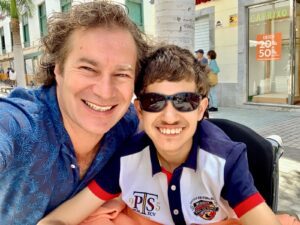

Juan spent two decades searching for anything that might help his son Juanito, the oldest known person living with Menkes disease. Five thousand miles away, Vishal Gohil, Ph.D., was chasing the same answer in a Texas A&M University lab. (Courtesy photo/Juan Corchero, left; Hannah Lang/Texas A&M AgriLife, right)
An even rarer form of a rare disease
Juan remembers his son’s first nine months as ordinary. Juanito ate, grew and hit every milestone a father hopes to see. Then, almost overnight, things reversed.
Doctors spent a year and a half searching for an explanation while Juanito lost strength in his hands, his neck, his legs. It was the texture of his son’s hair, oddly kinked and colorless, that finally pointed a visiting doctor toward an answer he had only read about in textbooks: Menkes disease. A genetic test, run in a lab in France because none in Spain could confirm it at the time, came back positive when Juanito was 2 years old.
The disease traces back to a single broken gene. In a healthy body, copper absorbed through the gut travels into the bloodstream, then to the liver, and finally across the blood-brain barrier into the brain, where it helps mitochondria, the powerhouse of the cell, produce energy inside every neuron. In Menkes patients, a mutated protein called ATP7A cannot move that copper where it needs to go. It gets stuck at the very barriers meant to protect the body’s most important organ.
Juanito’s case, doctors would later learn, was different from most. His mutation left him with a low functioning ATP7A allowing a small amount of copper transport, somewhere between 10-20% of what a healthy child would have. It was not enough to stop the disease, but it has been enough, decades later, to make him the oldest person known to be living with Menkes disease.
Solving half the equation
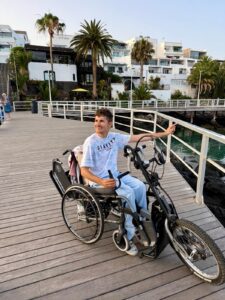 For nearly two decades, weekly copper injections gave Juanito (pictured right) strength that Menkes children rarely get to keep, but they could never fully reach his brain. Years later, a Texas A&M-developed drug called elesclomol would finally make that crossing, reducing his seizures and improving his quality of life. (Courtesy photo/Juan Corchero)
With no approved treatment anywhere in the world, Juan and his wife tracked down a therapy used experimentally in Austria: copper histidine injections, delivered by hospital staff once a week for the rest of Juanito’s life. It was, as Juan described it, “the only option.”
Within a month, Juanito’s body responded. Injected straight into his bloodstream, the copper skipped past the very first barrier the disease blocks, the one in his gut, and reached his muscles for the first time. He grew stronger from his head down to his hands. For nearly two decades, the family raised his dose as he grew, watching him hold on to strength that Menkes children rarely get to keep.
But getting copper into the blood was only half the journey. The same broken protein that had kept it from crossing Juanito’s gut, ATP7A, is also the only way copper can cross from the bloodstream into the brain. No matter how much copper reached his blood, very little of it could complete that second crossing.
“His mind was not growing at the same speed as his body,” Juan said.
Around age 18, the gains stopped. Juanito’s brain, like any young adults, was finishing its growth window, while his body still needed more copper than the treatment alone could safely deliver. Doses that once helped began causing seizures and liver strain instead. The family had reached what they thought was the ceiling of what medicine could offer their son.
Proof was in the yeast
The ceiling, it turned out, was about to move.
Five thousand miles away in College Station, Gohil had spent years chasing a basic question long before it had anything to do with Menkes disease: how does copper get into the mitochondria of a cell?
He studied it first in the simplest organism available, the same strain of yeast used to bake bread and brew beer. When his lab deleted a single gene involved in ferrying copper into those cells, the yeast grew sick. That sickness became a tool. Gohil’s team began testing copper-binding compounds to see which ones could rescue the yeast, and one stood out from the rest by a wide margin: a molecule called elesclomol.
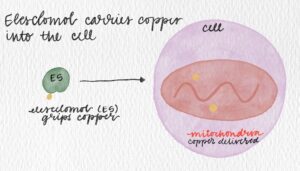
The drug elesclomol grips copper and carries it across the cell membrane to the mitochondria on its own, reaching the places a Menkes patient’s broken protein cannot. (Illustration by Anna Haley/Texas A&M AgriLife)
It worked at concentrations a million times smaller than a milligram. It worked in zebrafish bred with a broken copper transporter. In mice with a condition that closely mirrors human Menkes disease, two early injections of elesclomol paired with copper let them live a full, normal lifespan of about two years. Untreated, these mice typically die within two weeks of birth.
For Gohil, the science was also personal. As a teenager in India, he watched his mother endure years of hospitalization and multiple surgeries for a rare disease of her own. It was what first pulled him toward rare disease research, a field where patients are so few and so scattered that they often go unnoticed by the kind of large-scale research it usually takes to develop a new drug.
“That really becomes the responsibility of academic researchers like us,” Gohil said.
Proving it took years of testing across yeast, zebrafish and mice. Turns out elesclomol does not need a working transporter at all. The drug carries copper straight through cell membranes on its own, past the very barriers broken in Menkes patients, and all the way into the mitochondria that need it, including those in the brain.
Making the case for Juanito
Word of that breakthrough didn’t stay in the lab for long. Juan had more experience than any other Menkes parent in Spain. His son was, after all, the oldest boy in the world with the disease, and when new families found out their child had Menkes, Juan was often the first call they made.
In 2024, Juan traveled from the Canary Islands to a Menkes conference in Málaga to make his own case directly to Gohil. Doctors had told him his son, in his early 20s, was too old for elesclomol, a treatment being reserved for infants fighting for their first year of life.
But Juan had seen what elesclomol had done for a younger boy named Marco, the first child ever treated, and refused to let his son’s age close the door.
Because Juanito’s rare, partial form of the disease let him respond quickly to treatment, Juan believed his son was not a long shot but a genuine opportunity to learn something new. Gohil agreed. It still took two more years to secure the appropriate approvals and access, but on Christmas week of 2024, more than two decades after his diagnosis, Juanito received his first dose of elesclomol.
“We feel Juanito is more connected to us. He doesn’t speak, but we understand him. It’s easier to do everything now.” – Juan Corchero, Juanito’s Father
Copper histidine had kept Juanito alive for two decades and let his body grow, but it could never fully reach his brain. Elesclomol was the first treatment that could, and the difference showed up fast.
Within two months, the seizures that had defined Juanito’s life for years nearly disappeared. In a year and a half, he has had only one. He gained more than 10 pounds of muscle. He learned to fold down his own eating tray, work a fork, identify a tree or a car in a picture, and play table games with his fingers instead of struggling to hold anything at all.
“We feel Juanito is more connected to us,” he said. “He doesn’t speak, but we understand him. It’s easier to do everything now.”
Answers for patients and research
In 2025, The Texas A&M University System recognized Gohil’s work with a System-wide Innovation Award. Ask him about the research, though, and he skips past the enzyme, the papers he published and the molecule he spent over a decade chasing. He talks about Juanito and Juan, the patients and parents who needed an answer after being told for years there was nothing anyone could do.

When no one else answered the call from families facing Menkes disease, Vishal Gohil, Ph.D., did. His Texas A&M lab spent over a decade developing the treatment that reached Juanito. (Hannah Lang/Texas A&M AgriLife)
Juan messages Gohil over WhatsApp every few weeks with updates: a video of Juanito standing a little longer, a photo of him drawing, a note that he’s had a good week. Gohil answers, asks how Juanito’s legs are holding up between injections, and checks in on the family the way he’d check in on his own.
“He’s so invested in helping,” Juan said. “Vishal is always on the other side of the phone for anything, any question.”
For years, families searching for a way to help their Menkes’ children ran into the same wall: doctors with no treatment to offer, and a disease too rare for most researchers to take on. When no one else answered the call from parents of Menkes patients, Gohil did.
Somewhere on Lanzarote tonight, Juanito will unfold the tray on his wheelchair, pick up his fork and eat on his own. His father will watch him do it, 24 years after being told there was nothing left to try.
Science with a purpose
Gohil’s research is part of a larger effort at the Texas A&M Department of Biochemistry and Biophysics, where scientists study the molecular machinery of life to solve problems in health and medicine. Learn more about their work.